Author: Rediscovered Astronomy

  • New Galaxy Map

    New Galaxy Map

    New Milky Way Galaxy Map

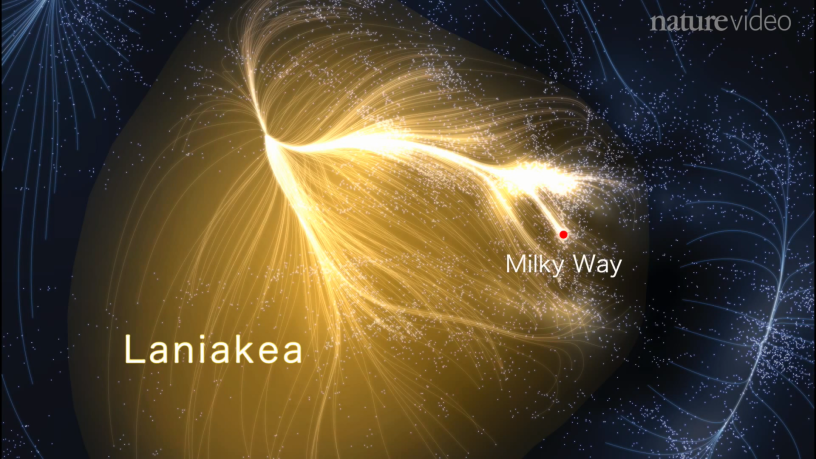
    A new cosmic map has been released by astronomers. The new galaxy map shows the Milky Way as part of a larger system of galaxies or a supercluster called Laniakea. These superclusters of galaxies are spread throughout the universe with dark voids filling up the rest of the space.

    The map was developed by a team from the University of Hawaii. Brent Tully led the study of the motions of the galaxies that surround the Milky Way. Despite the universe continous expansion, they found out that there is a force attracting most of these superclusters towards a center in the universe. The researchers named this center The Great Atractor. The team discovered galaxies travel along pathways in the universe and it is these pathways that help form the superclusters of galaxies. These superclusters neighbor each other much the same way galaxies do. Our super cluster known as Laniakea is home to the Milky Way and has its neighbor supercluster, Perseus-Pisces.

    Nature

    Source: Nature, University of Hawaii

    © Rediscovered Astronomy

  • Space X Falcon 9 R Explosion

    Space X Falcon 9 R Explosion

    Space X Falcon 9 R Explosion on Video

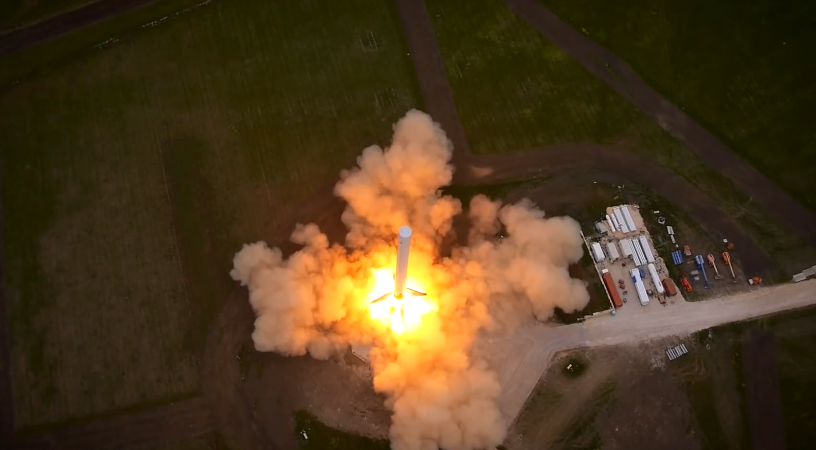
    Something went wrong with the launch of a Falcon 9 R rocket last Friday. The video of its explosion was aired this weekend by local TV. The rocket was launched from Space X facility near McGregor, Texas. The American company has not released any technical information related to the causes of the explosion.

    Visit our Solar System page.

    Follow us on YouTube.

    © Rediscovered Astronomy

  • Space X Falcon 9 First Test Flight

    Space X Falcon 9 First Test Flight

    Elon Musk’s Space X is on the way to fill the empty NASA has left now with the first successful test of the Falcon 9 Reusable Rocket.

  • Lunar Rover from China Lands on the Moon

    Lunar Rover from China Lands on the Moon

    The latest lunar landing by any country has been made. China’s lunar rover, Yutu [Jade Rabbit], has touched the surface of the moon.

    Only America (The United States) and Russia (the USSR) had achieved such a success with their space programs.

    Lunar Rover from China Lands on the Moon

    China’s apparent lunar landing  raises the question of what  they’ll do next.

    Will they follow the footsteps of the U.S. and USSR programs, or will they learn from their mistakes by setting themselves apart?

    Only time will tell.

  • Comet ISON Approach To Mars

    Comet ISON Approach To Mars

    Comet ISON is racing towards the inner solar system. This is the comet astronomers had said back in 2012 it would become “brighter than the moon”.  October 1, 2013 is when ISON begins its close approach to Mars and from there to Earth on its first approach to our planet.

    We will see how the tail of the comet behaves if ISON survives its approach to SOL around November 27, 2013.

    For now, Mars and ISON appear towards the East early morning, that is, provided you have enough zooming power to get a glance of it.

    The following Celestia animation shows ISON’s approach to Mars. We are looking at both bodies at a distance of  ~.40 AU.

  • Space X Grasshopper Vertical Landing Rocket

    Space X Grasshopper Vertical Landing Rocket

    Grasshopper (Space X) Vertical Landing Rocket reached the height of 325 meters in its most recent test. Space X hopes to revive rockets’ vertical landing systems as a viable way to reuse space vehicles.

    Space X –  Grasshopper

    Visit our Solar System page.

    Follow us on YouTube.

    © Rediscovered Astronomy

  • India Launches Rocket

    India Launches Rocket

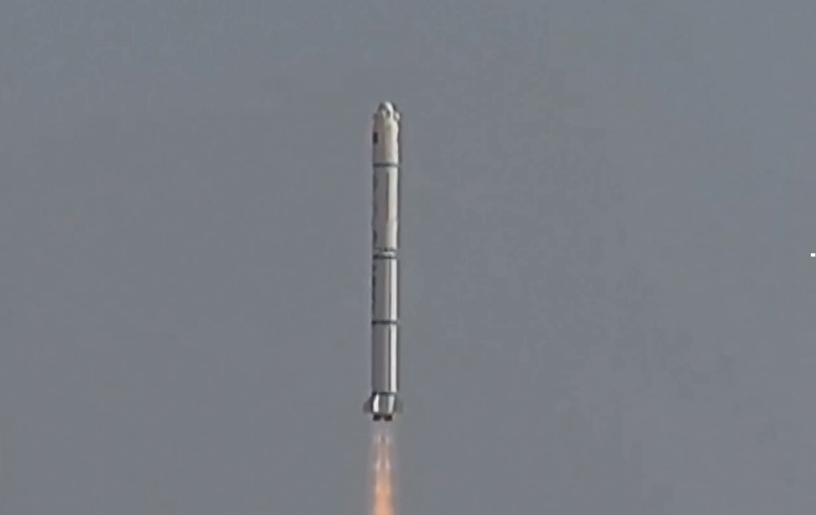
    India launched its space rocket PSLV to place in orbit a navigational satellite. The satellite is the first of seven to be put into orbit by India as part of their Regional Navigational System

    India Launches Rocket
  • Three X Solar Flares In Less Than 24 hours

    Three X Solar Flares In Less Than 24 hours

    Our sun [Sol] has released three X-type-solar flares from an active sunspot. The solar flares were X1, X2, and the most recent one of magnitude X3.2, the biggest so far in the year. It is expected that the sun rotates to face this active sunspot towards Earth. Researchers have estimated that a direct hit of a major X-type solar flare on Earth could cripple unprotected electric grids, telecommunication satellites, and electronics.

    It’s been over 150 years since a major X-type solar flare hit the Earth directly.

  • Latest Achievement Of China In Space Technology

    Latest Achievement Of China In Space Technology

    Latest Achievement Of China In Space Technology

    ITN

    Visit our Solar System page.

    Follow us on YouTube.

    © Rediscovered Astronomy

  • Meteorites In Mexico and Argentina Appear Before Earthquake

    Meteorites In Mexico and Argentina Appear Before Earthquake

    Mexico Meteorites

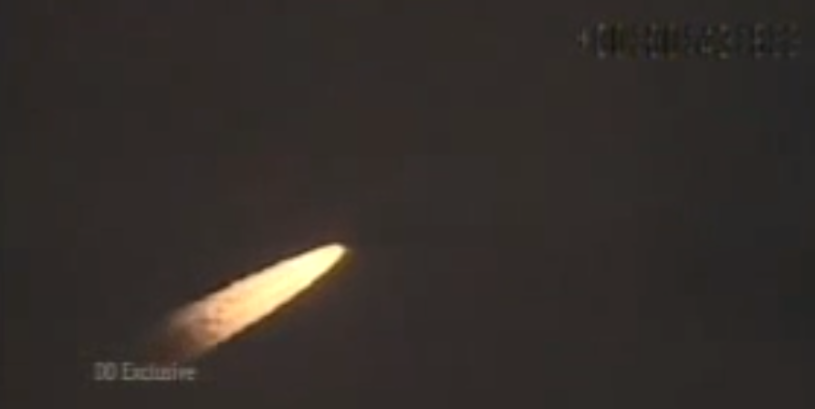
    Two meteorites, one over México before an earthquake and another in Argentina were spotted last April the 21st, 2013. These constitute the last in a series of meteorites reported and filmed in the last months, including the one over Russia.These phenomena may point to an increase in the number of rocks falling into Earth’s atmosphere. The cause? Scientists do not agree, but together with the increase in the number of non-periodic comets that are approaching the inner solar system make for an interesting 2013/2014 sky watch. Astronomy Rediscovered will publish an article in the next weeks [May or June] about the probable causes for the increase in Oort cloud comets visiting the sun; that is according to some astrophysicists’ research.

    Visit our Solar System page.

    Follow us on YouTube.

    © Rediscovered Astronomy