
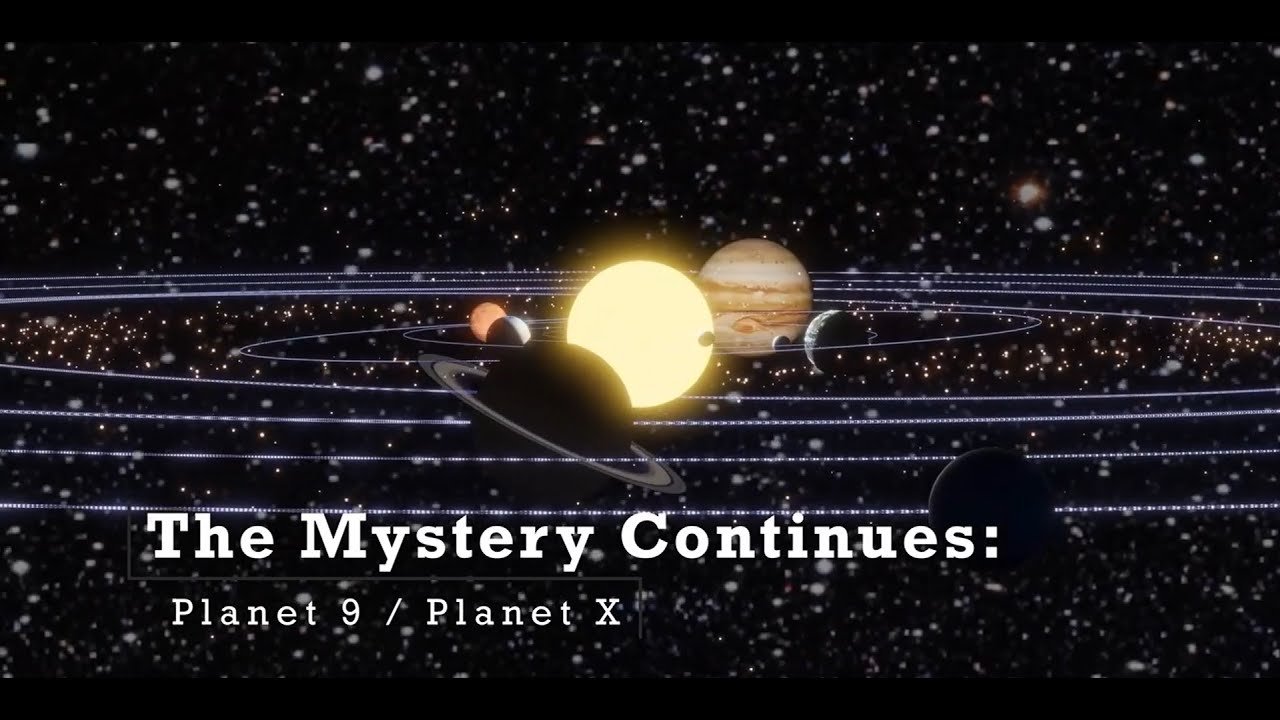
Comet c/2023 A3 has revived the search for a massive body in the Outer Solar System. Join our podcast hosts to trace the history behind this elusive planet.
Author: Rediscovered Astronomy
-
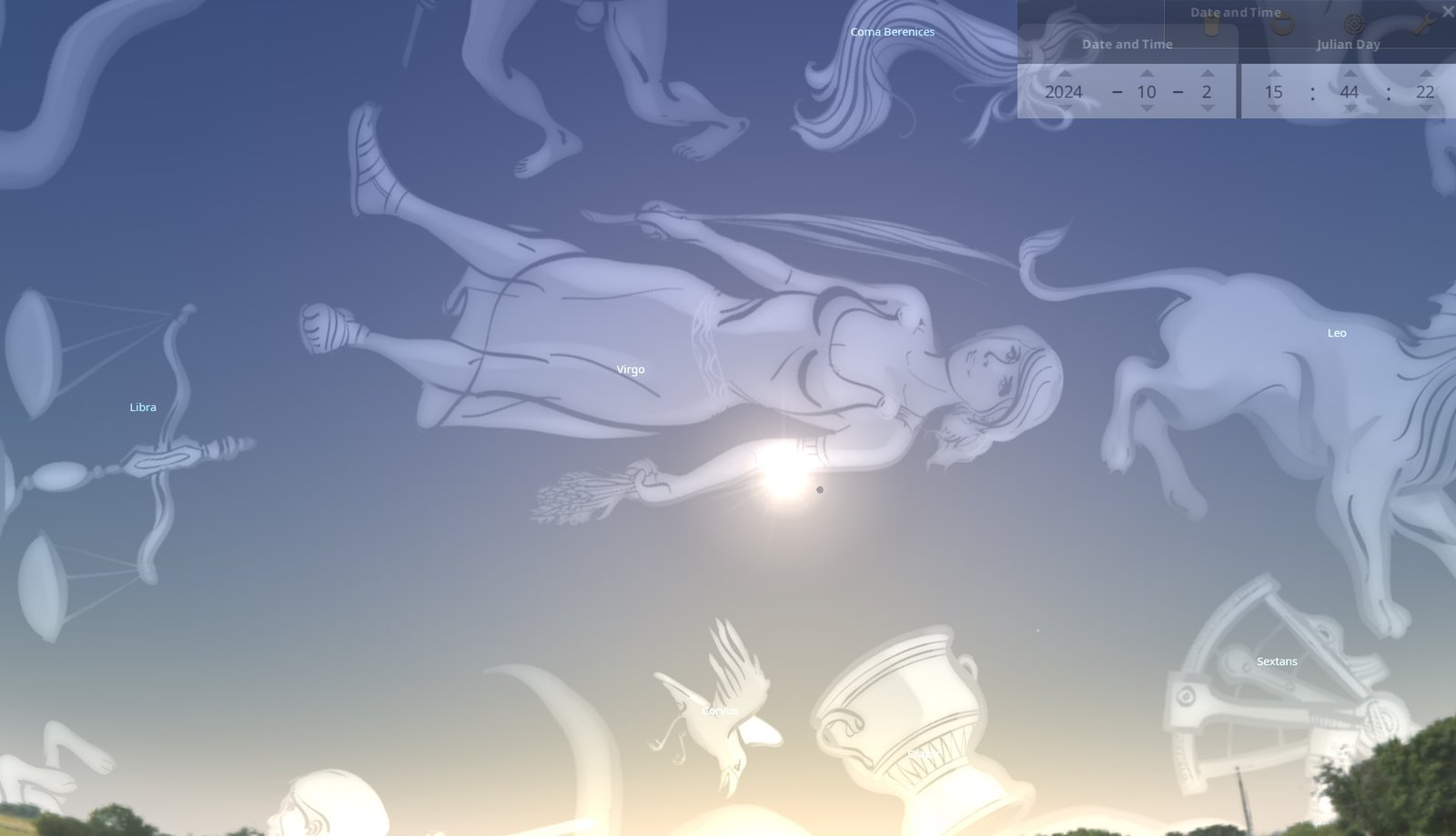
Annular Solar Eclipse 10-02-2024
Annular Solar Eclipse October 2, 2024
This solar eclipse of October 2, 2024 is the third astronomical event in a series that will end with not one, but two spectacular planetary alignments. that you won’t want to miss
The solar eclipse happening 4 days from now on October 2, 2024! will sweep across parts of the South Pacific and South America, with the path of totality passing through Chile and Argentina. If you’re in other places, you’ll get to experience a partial solar eclipse.
The Sun, Moon, and Mercury will be near Virgo the day of the Eclipse | Stellarium Solar Eclipses
But what exactly happens during a total solar eclipse? Let’s break it down!
The eclipse begins with the partial phase, where the moon starts to move in front of the sun. As it progresses, the light will gradually dim, and temperatures may drop. Then, for those in the path of totality, there will be a brief moment—totality—when the moon completely obscures the sun.
During totality, you can safely remove your eclipse glasses and witness the sun’s corona—a stunning halo of light that’s usually hidden by the bright light of the sun. It’s a rare and breathtaking sight!
People gather, share the moment, and it creates a sense of unity among strangers. Societies have viewed eclipses over time, from omens to scientific opportunitiesHere are a few tips to watch the eclipse:
- First, make sure you have a pair of eclipse glasses—regular sunglasses won’t cut it.
- If you’re in the path of totality, make sure to arrive early to find a good viewing spot.
- And don’t forget to check the weather forecast!
The day of the eclipse in South America | Stellarium
Remember, you can only look at the sun safely without glasses during totality. Otherwise, keep those glasses on to protect your eyes!
Are you in Chile or Argentina? Aer you planning to watch the eclipse?
The start of the eclipse will be at 3:57 p.m. [Chile Summer Time] and it will end at 6:46 p.m. [Argentina Time]
The past of totality will start in the Pacific and will cross the souther part of South America by Chile and Aregtina to end in the South Atlantic Sea.
Unfortunately, of you are in North America and other parts of the world, you won’t see much of the solar eclipse.Until next time, keep looking up and stand in awe before the wonders of our own solar system!
Don’t forget to subscribe to our YouTube channel and hit that notification bell so you won’t miss our future astronomy content.
We’ll keep you updated on more astronomical events and space news as they approach -
Virgo
Virgo Constellation
Virgo is one of the largest and most fascinating constellations in the night sky. It represents a woman. Virgo, the Virgin, is the second largest constellation, covering an area of about 1,294 square degrees. You can find it in the southern sky, best visible from late winter to early summer in the northern hemisphere. Its brightest star, Spica, shines with a bluish hue and is located about 250 light-years away from us.
So let’s get started!
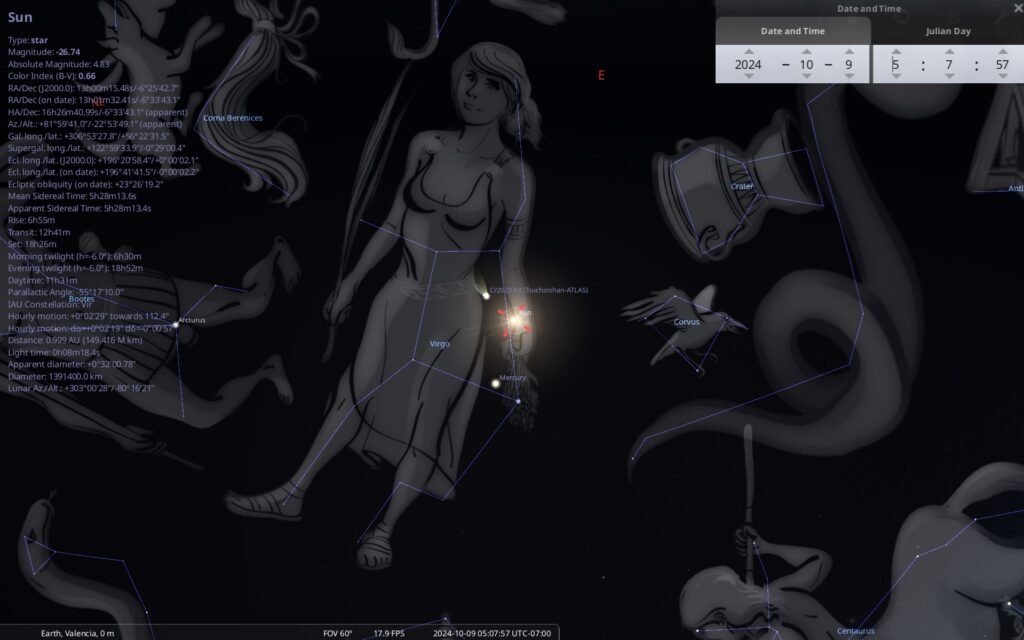
Virgo Constellation | Stellarium Mythology and History
Like many constellations, Virgo has its roots in mythology. In Greek mythology, Virgo is often associated with Demeter, the goddess of agriculture, and her daughter Persephone. The constellation’s position in the sky symbolizes the harvest season, making it an important figure in many cultures.

Artistic representation of Greek Goddess Demeter In other cultures, Virgo has been depicted differently. For example, in ancient Egypt, Virgo was associated with the goddess Isis, symbolizing fertility and agriculture.
Key Stars and Features
Now let’s talk about some of the key stars in Virgo. Spica is the standout star, but did you know it’s actually a binary star system? That means it has a companion star orbiting it, which we can’t see with the naked eye. This gives Spica an incredible brightness, making it one of the top 20 brightest stars in the night sky!

Binary System, Artist Porrima (Gamma Virginis) is a double star system that is difficult to resolve without a telescope. It’s located relatively close to Earth, about 38 light-years away.
Zavijava (Beta Virginis) is a main-sequence star that is part of the constellation’s distinctive shape.
The Virgo Cluster is part of the larger Virgo Supercluster, which includes our Milky Way galaxy. This cluster contains many galaxies, such as M 49, M87, M86, and M84.
Messier 49 is a bright elliptical galaxy located within the Virgo Cluster, which can be viewed with moderate telescopes.
Messier 86 is another galaxy in the Virgo Cluster, notable for its unusual shape and orientation.
It’s a focal point for observational astronomy, and several studies of galaxy formation and evolution have been conducted in this region.
Stargazing
Alright, so how can you spot Virgo in the night sky? The easiest way is to look for Spica, which can guide you to the rest of the constellation. Look for a pattern resembling a large ‘Y’ shape. During spring evenings, Virgo is high overhead, so it’s a perfect time to take your telescope out!You can also use the Big Dipper as a guide; you can draw an imaginary line from the pointer stars to locate Virgo. Spica will help you pinpoint the constellation’s location. But remember, try to find a dark area away from city lights, preferably during spring when Virgo is most prominent.
Fun Facts
Here are a few fun facts about Virgo:- Virgo contains the famous Messier 87, which is home to the first-ever black hole image captured by the Event Horizon Telescope.
- The constellation is often associated with fertility and abundance, which is why many ancient cultures revered it.
- Virgo is also home to several notable meteor showers, including the Virginids, which can be observed in April.
Thanks for joining us on this cosmic journey through Virgo!
Don’t forget to subscribe to our YouTube channel and hit that notification bell so you won’t miss out on our next adventure through the stars. -

Comet C/2023 A3
Comet C/2023 A3 Tsuchinshan-ATLAS
The second date to remember is September 27, 2024 as this will be Comet C/2023 A3 Tsuchinshan-ATLAS closest approach to the Sun or perihelion. However, this is not the only date to keep in mind for this series of astronomical events that started with the partial Lunar Eclipse of last September 17-18, 2024. If you’re still here, keep reading ahead.

Actual photo of C/2023 A3 taken in June of 2024 Discovery
Comet C/2023 A3 was discovered in 2023, it’s a long-period comet, which means it takes a really long time to orbit the Sun—think thousands of years! This one’s making headlines because of it may have a bright tail after its close approach to the Sun, and Earth.
Comet C/2023 A3 was spotted by astronomers using advanced telescopes. Its orbit is fascinating, since it swings in from the Oort Cloud and heads back out into deep space. As it gets closer to the Sun, the heat causes it to release gas and dust, creating that stunning tail we may be able to see.
Stargazing
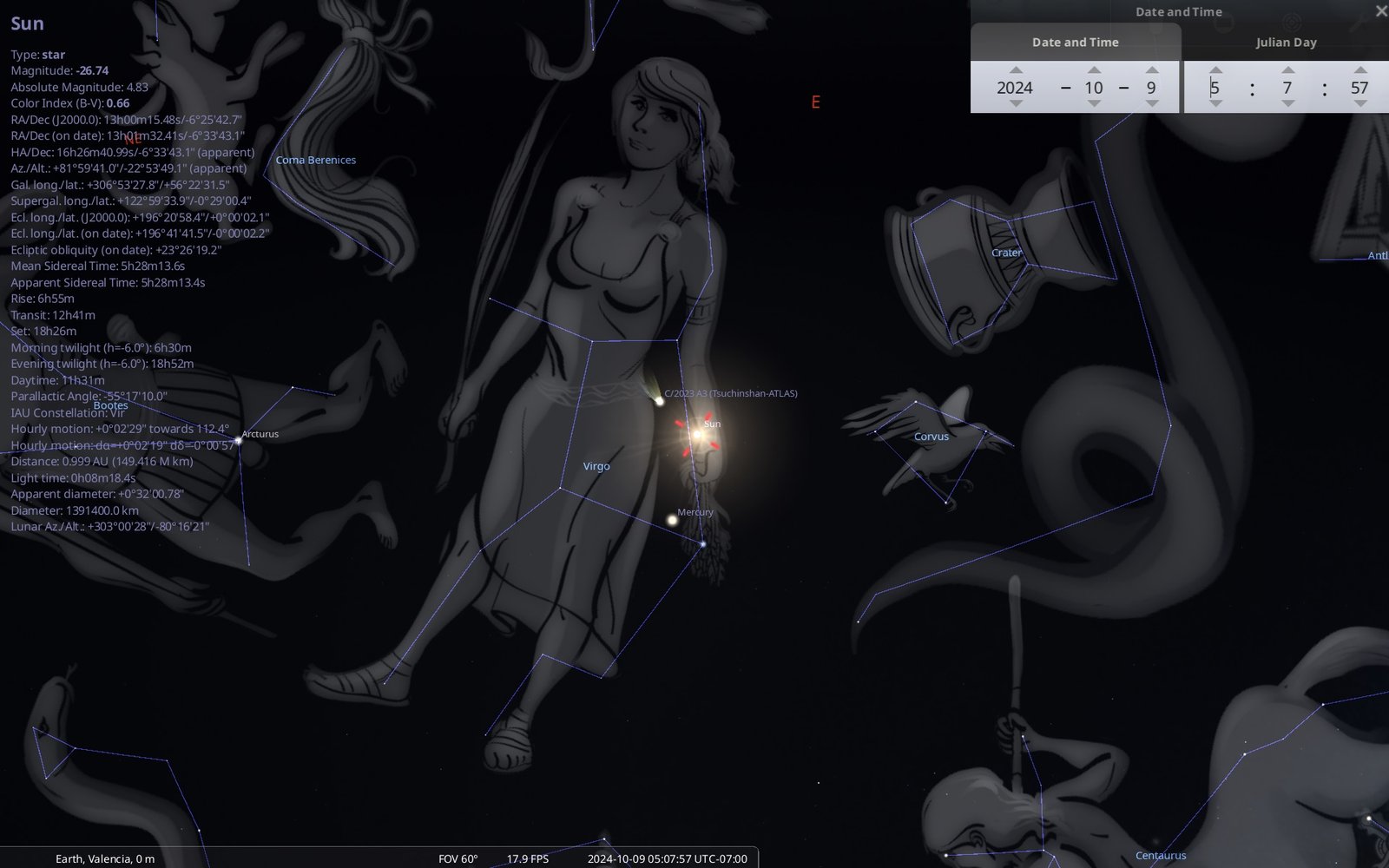
Now, for all you stargazers out there—when can you see it? C/2023 A3 is expected to make its closest approach to Earth on October 12 of 2024; however, it is expected to be the brightest on or around October 9, 2024. During this time, it could be visible with binoculars or even the naked eye in dark areas. Keep an eye on the sky, especially during early mornings or late evenings.
Comets are more than just beautiful sights; they’re like time capsules from the early solar system. Studying them helps scientists understand the origins of our planetary system, and maybe even the building blocks of life.

Comet Tsuchinshan-ATLAS the night of September 27, 2024 | Stellarium If you want to catch a glimpse of Comet C/2023 A3, here are some tips:
- Grab a pair of binoculars or a telescope if you have one.
- Find a dark location away from city lights.
- Use a stargazing app to help you locate it in the sky.
- Take some snacks—you might be out there for a while!
That’s it for today’s cosmic adventure!
Are you excited to see Comet C/2023 A3? Let us know!

Comet C/2023 A3 the night of October 9, 2024 | Stellarium
Don’t forget to subscribe to our YouTube channel and hit that notification bell for more space updates.
Until next time, keep looking up!Sources: I.A.U. Minor Planet Center / NASA – JPL – CalTech Small Body Database
-

Lunar Eclipse September 17 – 18, 2024
Today’s Lunar Eclipse will start a series of awe inspiring astronomical events that will span for months and which will culminate with a spectacular planetary alignment.
But let’s focus on today’s event, a lunar eclipse happening on September 17 – 18, 2024, depending where you are in the world.
So, what’s the big deal about this lunar eclipse? For starters, it’s going to be a partial lunar eclipse, which means the Earth will partly cover the Moon.
This isn’t just any lunar eclipse, though. It’s going to be visible from a wide range of locations, including much of North and South America, Europe, and Africa. So, no matter where you are, you might just get a front-row seat to this cosmic show!
Here’s a quick rundown of what to expect:
The eclipse will begin with the partial phase around 5:41 pm PST [12:41 am UTC on Spetember 17 [18 UTC] where the Moon will start to slip into Earth’s shadow. The maximum eclipse will start around 7:44 p,m. PST [2:44 a.m. UTC on Septemner 18] and will last for approximately 30 minutes. The entire event will conclude with the partial eclipse ending around 9:47 p.m. PST on Spetember 17 [4:47 a.m. UTC on September 18].
If you want to catch the best view, you’ll need to find a spot with a clear, unobstructed view of the sky. You don’t need any special equipment to see the eclipse—just your eyes will do. However, if you have a telescope or binoculars, you’ll get a fantastic close-up view of the Moon’s surface and the shadow play.
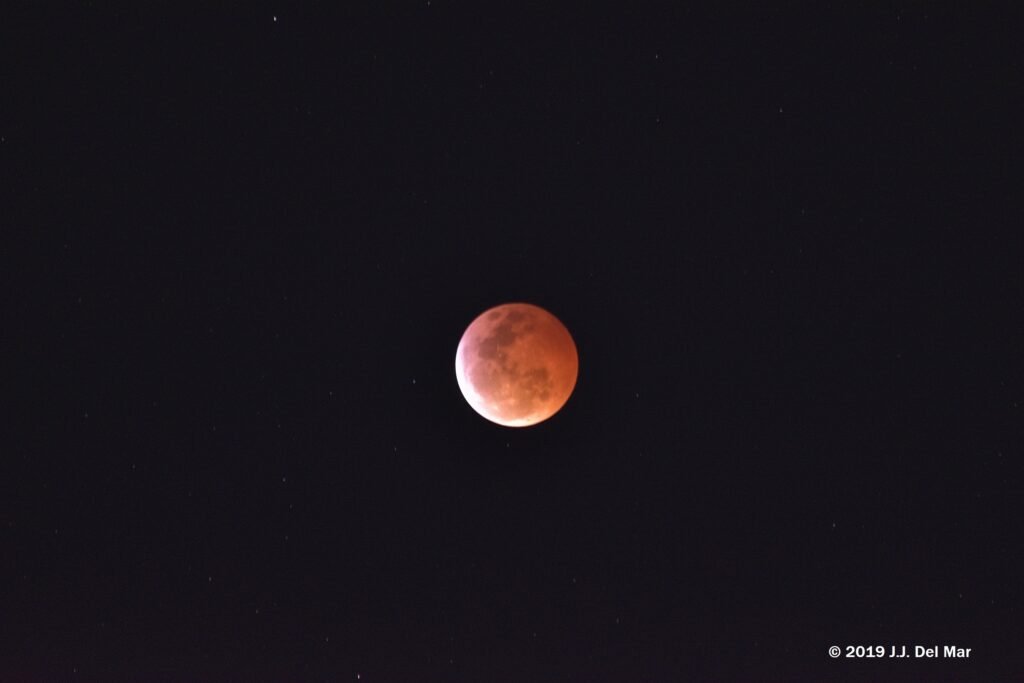
Blood Moon 2019 One of the most incredible parts of a lunar eclipse is seeing the Moon change colors. As the Earth’s shadow slowly moves across the Moon, you’ll notice it turn from a bright white to a deep red, with shades of orange and brown in between. This happens because of a phenomenon called Rayleigh scattering, which causes the shorter blue wavelengths of sunlight to scatter out of the Earth’s shadow while the longer red wavelengths pass through.
For those of you who love stargazing or just want to witness something spectacular, this is definitely an event you won’t want to miss. It’s a beautiful reminder of the vastness and wonder of our solar system.
A couple of quick tips: make sure you’re in a place with minimal light pollution, and consider bringing a blanket or chair to make your viewing more comfortable. And, of course, don’t forget your camera if you want to capture the moment!
Thanks for stopping by, and see you next time!
If you’re new here, don’t forget to hit that subscribe to our YouTube channel and ring the bell so you don’t miss any of our future content.

-

Total Solar Eclipse 2024
Eclipse 2024 in North America
Whether you are in Mexico, the United States or Canada, you are set for a fascinating cosmic event. The Total Solar Eclipse of 2024 will be witnessed this April 8 by over 37 million people who will be in its path in the three countries that make North America.
Path of the 2024 Eclipse in North America | Great American Eclipse . com The two northern Maria Islands, Islas Marías, in Mexico will be the first inhabited places to see the Total Solar Eclipse in North America.** The first continental city to witness the event in North America will be the mid-size city of Mazatlán in the sate of Sinaloa, Mexico. The path of the eclipse will let people in well known cities in Mexico, the United States, and Canada see the cosmic spectacle.
Animation by NASA Goddard These are some places where to see the totality of the Eclipse in MEXICO:
- Revillagigedo Islands: Socorro Island Isla Socoro – **Mexican military post, no public access
- María Islands: Maria Madre Island Isla María Madre / San Juanito Island Isla San Juanito [north Isla María Magdalena, no totality in Isla María Cleofa]
- Mazatlán / El Habal / Puerta de Canoas / El Chilillo
- El Salto
- Durango [City]
- Ciudad Canatlán / El Progreso / Nuevo Ideal / Santiago Papasquiaro
- Diez de Octubre / Rodeo / Nazas
- Francisco I. Madero [Durango] / Guadalupe Victoria / Emiliano Zapata / Cuencamé
- Torreón / Gómez Palacio Metropolitan Area
- Francisco I. Madero [Coahuila] / Concordia / San Pedro de las Colonias
- Mapimí Biosphere Reserve [Reserva de la Biósfera Mapimí ] / Laguna de Palomas / Salina Laguna de Palomas in Chihuahua State
- Laguna del Rey [Coahuila]
- Cuatro Ciénegas
- San Buenaventura / Nadadores
- Monclova / Ciudad Frontera
- Sabinas / Nueva Rosita / Palau/ Múzquiz
- Allende / Zaragoza / Nava
- Piedras Negras
- Ciudad Acuña
*Bear in mind that Mexico does not have summer savings time anymore. So most of Mexico is U.S. CST [winter time] and not CDT, but minus one hour during this time of year for the Pacific Coast in Mazatlán.
Time is based on the beginning of totality in Mazatlán, México 12:06 CST / *1:06 CDT [11:06 am local time].
It will take approximately five more minutes to reach Durango, México 12:11 CST and ten more minutes to reach Torreón, México 12:16 CST.
If you live in the United States, you will have around 20 more minutes to start seeing totality in Texas. *13:26 CDTThese are some places where to see the totality of the Eclipse in the UNITED STATES:
TEXAS
- Eagle Pass
- Del Rio
- Carrizo Springs / Crystal City / Uvalde / Hondo
- [West] San Antonio
- Kerrville / Bandera / Boerne / Lakehills
- Austin
- Round Rock / Georgetown
- Killeen / Temple / Waco
- Dallas – Fort Worth Metro [No totality in Denton]
- Corsicana / Athens
- Greenville / Bonham
- Tyler
- Mount Pleasant / Paris / Texarkana
OKLAHOMA
- Broken Bow / Idabel
- Hugo / Antlers / Rattan
- Poteau
ARKANSAS
- Ashdown / Texarkana / Hope
- Hot Springs
- Russelville
- Conway
- Little Rock / Benton
- Searcy
- Jonesboro
MISSOURI
- Poplar Bluff
- Dexter / New Madrid / Sikeston
- Jackson / Scott City / Charleston
ILLINOIS
- Cairo
- Murphysboro / Carbondale / Marion
- Metropolis
- Mount Vernon / Centralia
KENTUCKY
- Paducah
- Marion
- Henderson
INDIANA
- Evansville / Vincennes
- Terre Haute
- Indianapolis
- Marion / Anderson / Muncie
- Bloomington / Columbus / Seymour
- Richmond
OHIO
- Hamilton / Middletown [north / northwest Cincinnati]
- Dayton / Spingfield
- Lima / Findlay / Toledo
- Dublin [northwest Columbus] / Delaware / Marion
- Cleveland / Akron
MICHIGAN
- Northeast Toledo Metro Area / North Lost Peninsula
PENNSYLVANIA
- Erie
- Meadville
NEW YORK
- Jamestown
- Buffalo
- Rochester
- Syracuse
- Watertown / Fort Drum / Plattsburgh
VERMONT
- Burlington
- Montpelier / St Johnsbury
- Enosburg / Morrisville / Newport
NEW HAMPSHIRE
- Lancaster
- Groveton
- Colebrook
MAINE
- Bingham / Greenville / Guilford / Dover-Foxcroft
- Lincoln / Millinocket / Houlton
- Ashland / Presque Isle / Caribou / Mars Hill
These are some places where to see the totality of the Eclipse in CANADA:
- Leamington / Blenheim / Ridgetown / St Thomas / Port Stanley
- Brantford / Hamilton
- St. Catharines / Niagara Falls / Welland
- Quinte West / Belleville / Napanee
- Kingston / Gananoque / Cornwall
- South Montreal / Longueuil
- Saint-Jean-sur-Richelieu / Saint-Hyacinthe / South Drummondville / Granby
- Sherbrooke
- Thetford Mines / Black Lake / Saint-Georges / Lac-Etchemin
- Miramichi / Tracadie-Sheila / Richibucto
- Alberton / Summerside / Kensington / North Rustico
- Îsles de la Madeleine [Madeleine Islands]
- Stephenville / Mouse Island / Port aux Basques
- Burgeo / Pool’s Cove
- Millertown / Buchans
- Grand Falls-Windsor / Bishop’s Falls
- Clarenville / Little Heart’s Ease / Little Catalina
For more about the Sun, the Moon, and our Solar System visit our planet page here.
Sources:
NASA© 2024 Rediscovered Astronomy
-

Rediscovered Astronomy Podcast Episode 1
The Search for Planet X
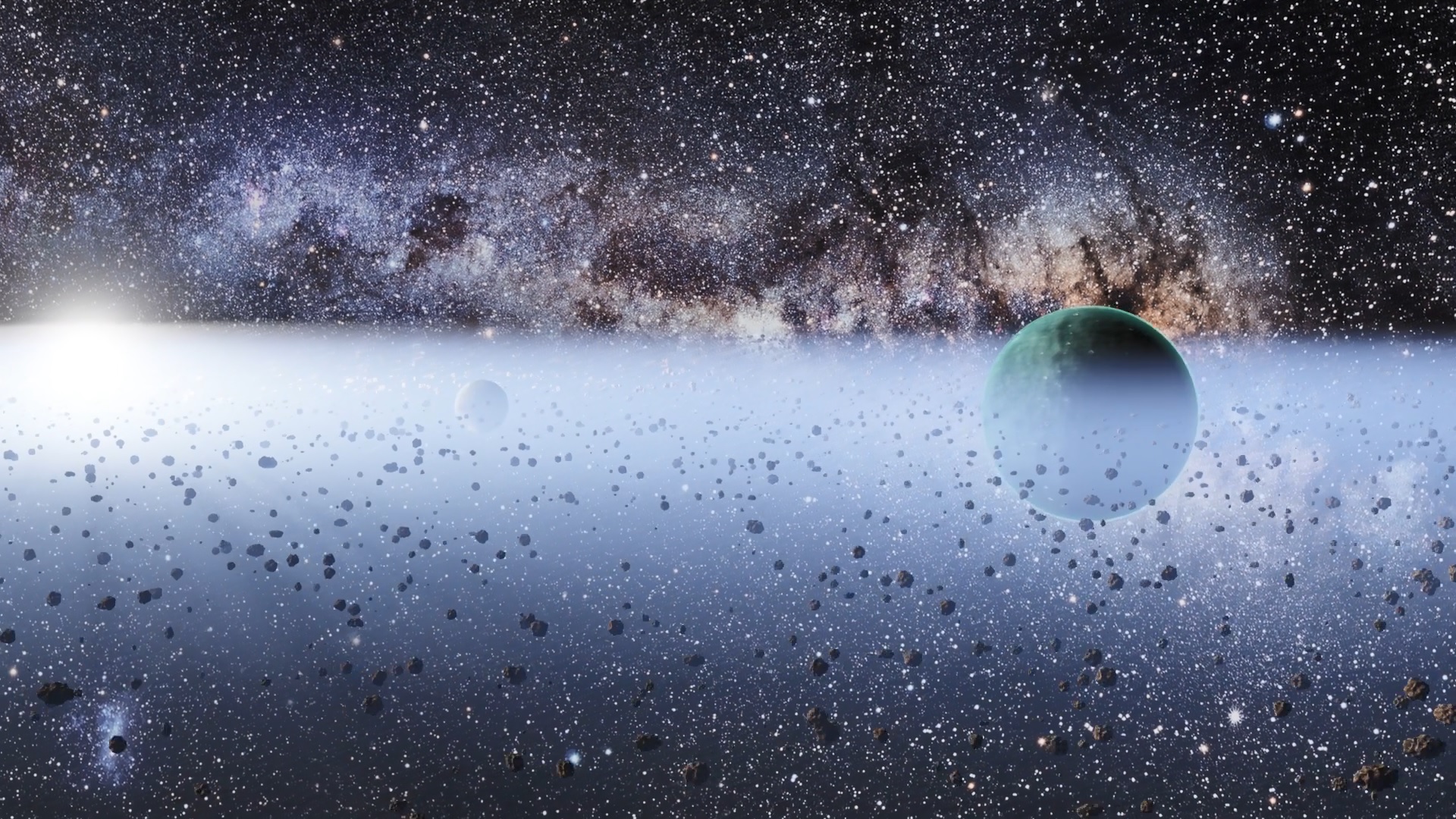
The search for a massive planet, from 2 – 10 Earth masses, has never stopped. The discovery of Sedna and later of Eris by Michael Brown and his team, not only would prompt the redefinition of what a planet is, but it would also be a key factor in the search for Planet X.
The discovery of 2012 VP113 in early 2014 by Scott Sheppard and Chad Trujillo supports and extends the current theories that propose the presence of another planet in the outer Solar System. 2012 VP113 [nicknamed Biden] lies at 80 Astronomical Units perihelion and 445 Astronomical Units aphelion.
Written by J.J. Del Mar for Rediscovered Astronomy
English: AI
Subscribe to our YouTube channel
Español enlace dé click aquí.
© 2023 Rediscovered Astronomy
-
Rediscovered Astronomy Podcast Episodio 1
La Búsqueda del Planeta X
La búsqueda de un planeta masivo, de 2 a 10 masas Tierra, nunca ha parado. El descubrimiento de Sedna y de Eris por Michael Brown y su equipo, no sólo provocó la re-definición de lo que es un planeta, sino también serían un factor clave en la búsqueda del Planeta X.
El descubromeinto de 2012 VP113 por Scott Sheppard y Chad Trujillo apoyan y extienden las teorías recientes que proponen la presencia de otro planeta en el Sistema Solar exterior. 2012 VP113 [apodado Biden] se encuentra a 80 Unidades Astronómicas (UA), perihelio, y a 445 UA, afelio.
Escrito por J.J. Del Mar para Rediscovered Astronomy
Suscríbete a nuestro canal de YouTube
English, click here
© 2023 Rediscovered Astronomy
-
Moon mysteries
From the enimga of its very creation to peculiar rock formations, many mysteries surround the Moon, Earth’s giant natural satellite.
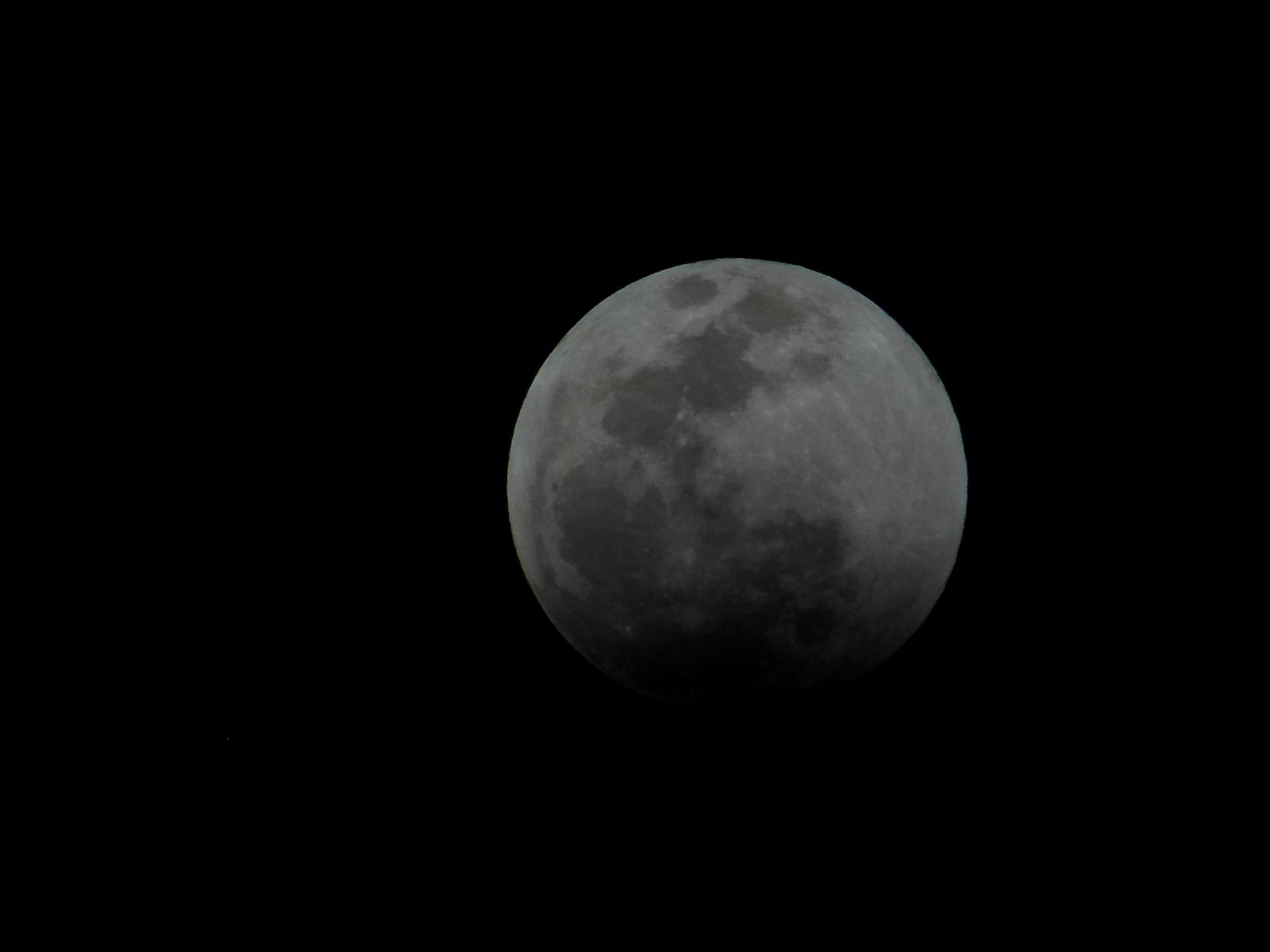
So pictures of the moon never get old. Here’s one picture of the moon when it starts to be overshadowed by Earth’s shape occurred during a lunar eclipse in 2019.
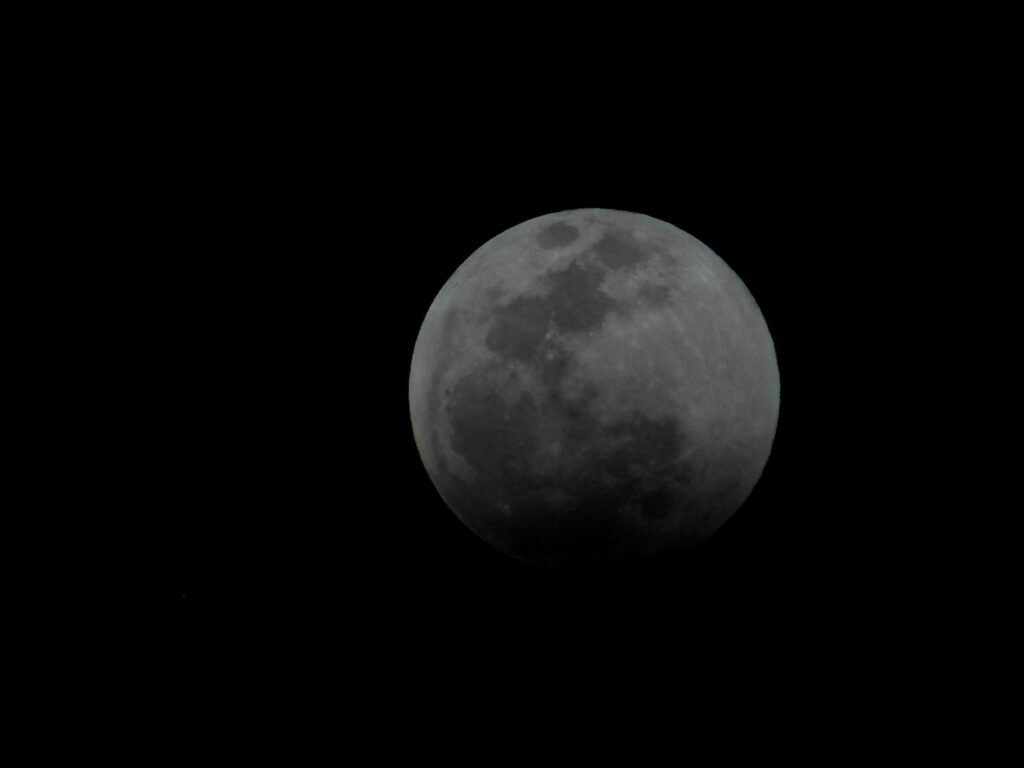
Rediscovered Astronomy | Photo: © J.J. Del Mar -

Space X Starship 9 Explodes During Test Flight
Starship 9 Explosion | Space X Flight Test
Spaceship Starship 9 of the Space X company exploded today during a test flight at the company’s space port in Boca Chica, Texas near the border with Mexico.
The Space X team was carrying out a test climb to 10 km and testing telemetry during the spaceship’s flight.
Moments before the landing, one of the engines did not fire and the controlled fall failed to stop Satrship 9 from crashing at the landind platform.
Space X Flight Test on February 2, 2021 at Boca Chica, Texas
Starship 9 Explosion | Video of the test flight
Today’s test flight is another in a series of tests Space X has been conducting in the last months.
Subscribe to our YouTube channel.