This solar eclipse of October 2, 2024 is the third astronomical event in a series that will end with not one, but two spectacular planetary alignments. that you won’t want to miss
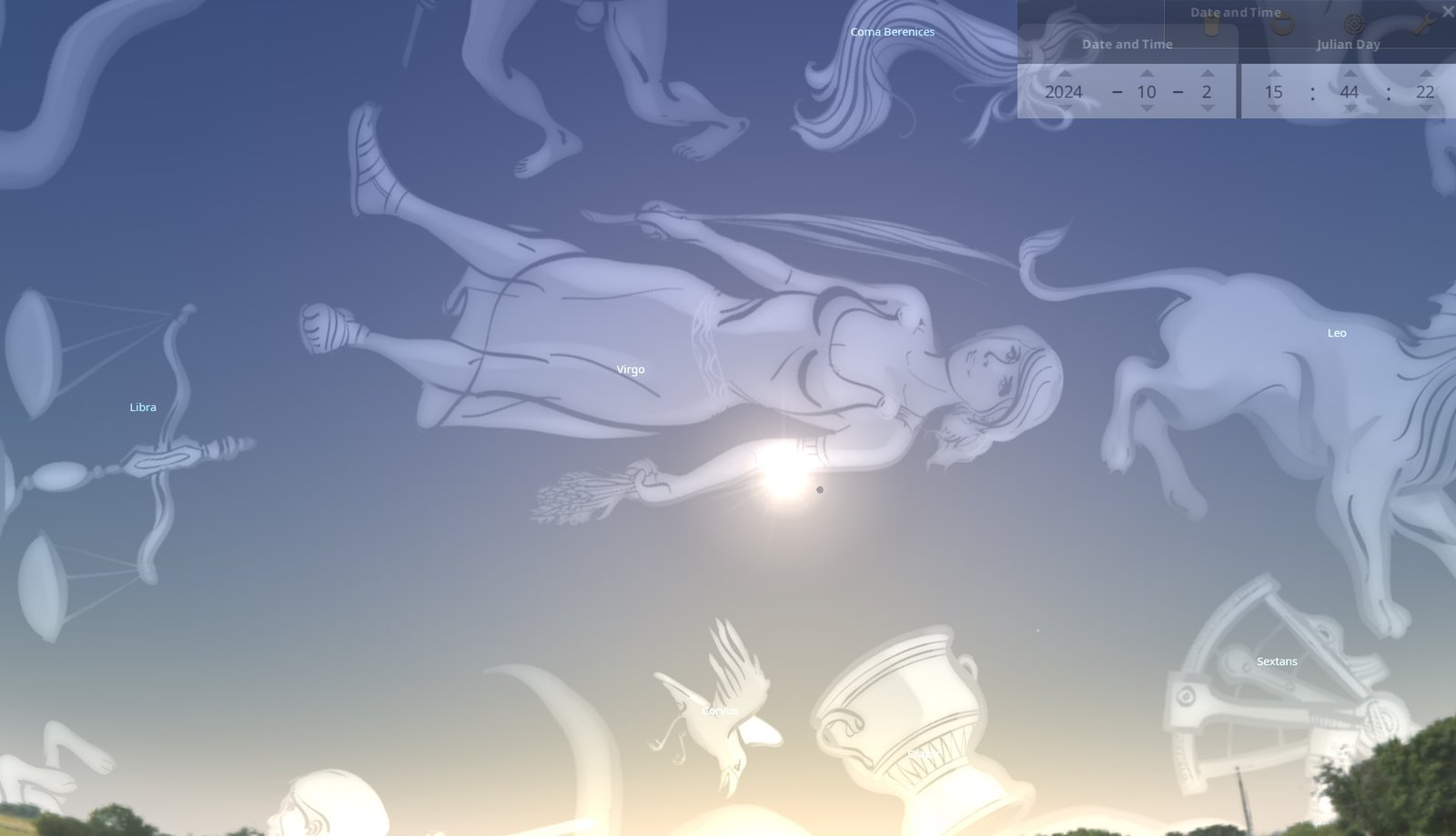
The solar eclipse happening 4 days from now on October 2, 2024! will sweep across parts of the South Pacific and South America, with the path of totality passing through Chile and Argentina. If you’re in other places, you’ll get to experience a partial solar eclipse.
The Sun, Moon, and Mercury will be near Virgo the day of the Eclipse | Stellarium
Solar Eclipses
But what exactly happens during a total solar eclipse? Let’s break it down!
The eclipse begins with the partial phase, where the moon starts to move in front of the sun. As it progresses, the light will gradually dim, and temperatures may drop. Then, for those in the path of totality, there will be a brief moment—totality—when the moon completely obscures the sun.
During totality, you can safely remove your eclipse glasses and witness the sun’s corona—a stunning halo of light that’s usually hidden by the bright light of the sun. It’s a rare and breathtaking sight!
People gather, share the moment, and it creates a sense of unity among strangers. Societies have viewed eclipses over time, from omens to scientific opportunities
Here are a few tips to watch the eclipse:
First, make sure you have a pair of eclipse glasses—regular sunglasses won’t cut it.
If you’re in the path of totality, make sure to arrive early to find a good viewing spot.
And don’t forget to check the weather forecast!
The day of the eclipse in South America | Stellarium
Remember, you can only look at the sun safely without glasses during totality. Otherwise, keep those glasses on to protect your eyes!
Are you in Chile or Argentina? Aer you planning to watch the eclipse?
The start of the eclipse will be at 3:57 p.m. [Chile Summer Time] and it will end at 6:46 p.m. [Argentina Time] The past of totality will start in the Pacific and will cross the souther part of South America by Chile and Aregtina to end in the South Atlantic Sea.
Unfortunately, of you are in North America and other parts of the world, you won’t see much of the solar eclipse.
Until next time, keep looking up and stand in awe before the wonders of our own solar system!
Don’t forget to subscribe to our YouTube channel and hit that notification bell so you won’t miss our future astronomy content. We’ll keep you updated on more astronomical events and space news as they approach
Virgo is one of the largest and most fascinating constellations in the night sky. It represents a woman. Virgo, the Virgin, is the second largest constellation, covering an area of about 1,294 square degrees. You can find it in the southern sky, best visible from late winter to early summer in the northern hemisphere. Its brightest star, Spica, shines with a bluish hue and is located about 250 light-years away from us.
So let’s get started!
Virgo Constellation | Stellarium
Mythology and History
Like many constellations, Virgo has its roots in mythology. In Greek mythology, Virgo is often associated with Demeter, the goddess of agriculture, and her daughter Persephone. The constellation’s position in the sky symbolizes the harvest season, making it an important figure in many cultures.
Artistic representation of Greek Goddess Demeter
In other cultures, Virgo has been depicted differently. For example, in ancient Egypt, Virgo was associated with the goddess Isis, symbolizing fertility and agriculture.
Key Stars and Features
Now let’s talk about some of the key stars in Virgo. Spica is the standout star, but did you know it’s actually a binary star system? That means it has a companion star orbiting it, which we can’t see with the naked eye. This gives Spica an incredible brightness, making it one of the top 20 brightest stars in the night sky!
Binary System, Artist
Porrima (Gamma Virginis) is a double star system that is difficult to resolve without a telescope. It’s located relatively close to Earth, about 38 light-years away.
Zavijava (Beta Virginis) is a main-sequence star that is part of the constellation’s distinctive shape.
The Virgo Cluster is part of the larger Virgo Supercluster, which includes our Milky Way galaxy. This cluster contains many galaxies, such as M 49, M87, M86, and M84.
Messier 49 is a bright elliptical galaxy located within the Virgo Cluster, which can be viewed with moderate telescopes.
Messier 86 is another galaxy in the Virgo Cluster, notable for its unusual shape and orientation.
It’s a focal point for observational astronomy, and several studies of galaxy formation and evolution have been conducted in this region.
Stargazing
Alright, so how can you spot Virgo in the night sky? The easiest way is to look for Spica, which can guide you to the rest of the constellation. Look for a pattern resembling a large ‘Y’ shape. During spring evenings, Virgo is high overhead, so it’s a perfect time to take your telescope out!
You can also use the Big Dipper as a guide; you can draw an imaginary line from the pointer stars to locate Virgo. Spica will help you pinpoint the constellation’s location. But remember, try to find a dark area away from city lights, preferably during spring when Virgo is most prominent.
Fun Facts Here are a few fun facts about Virgo:
Virgo contains the famous Messier 87, which is home to the first-ever black hole image captured by the Event Horizon Telescope.
The constellation is often associated with fertility and abundance, which is why many ancient cultures revered it.
Virgo is also home to several notable meteor showers, including the Virginids, which can be observed in April.
Thanks for joining us on this cosmic journey through Virgo!
Don’t forget to subscribe to our YouTube channel and hit that notification bell so you won’t miss out on our next adventure through the stars.
The second date to remember is September 27, 2024 as this will be Comet C/2023 A3 Tsuchinshan-ATLAS closest approach to the Sun or perihelion. However, this is not the only date to keep in mind for this series of astronomical events that started with the partial Lunar Eclipse of last September 17-18, 2024. If you’re still here, keep reading ahead.
Actual photo of C/2023 A3 taken in June of 2024
Discovery
Comet C/2023 A3 was discovered in 2023, it’s a long-period comet, which means it takes a really long time to orbit the Sun—think thousands of years! This one’s making headlines because of it may have a bright tail after its close approach to the Sun, and Earth.
Comet C/2023 A3 was spotted by astronomers using advanced telescopes. Its orbit is fascinating, since it swings in from the Oort Cloud and heads back out into deep space. As it gets closer to the Sun, the heat causes it to release gas and dust, creating that stunning tail we may be able to see.
Stargazing
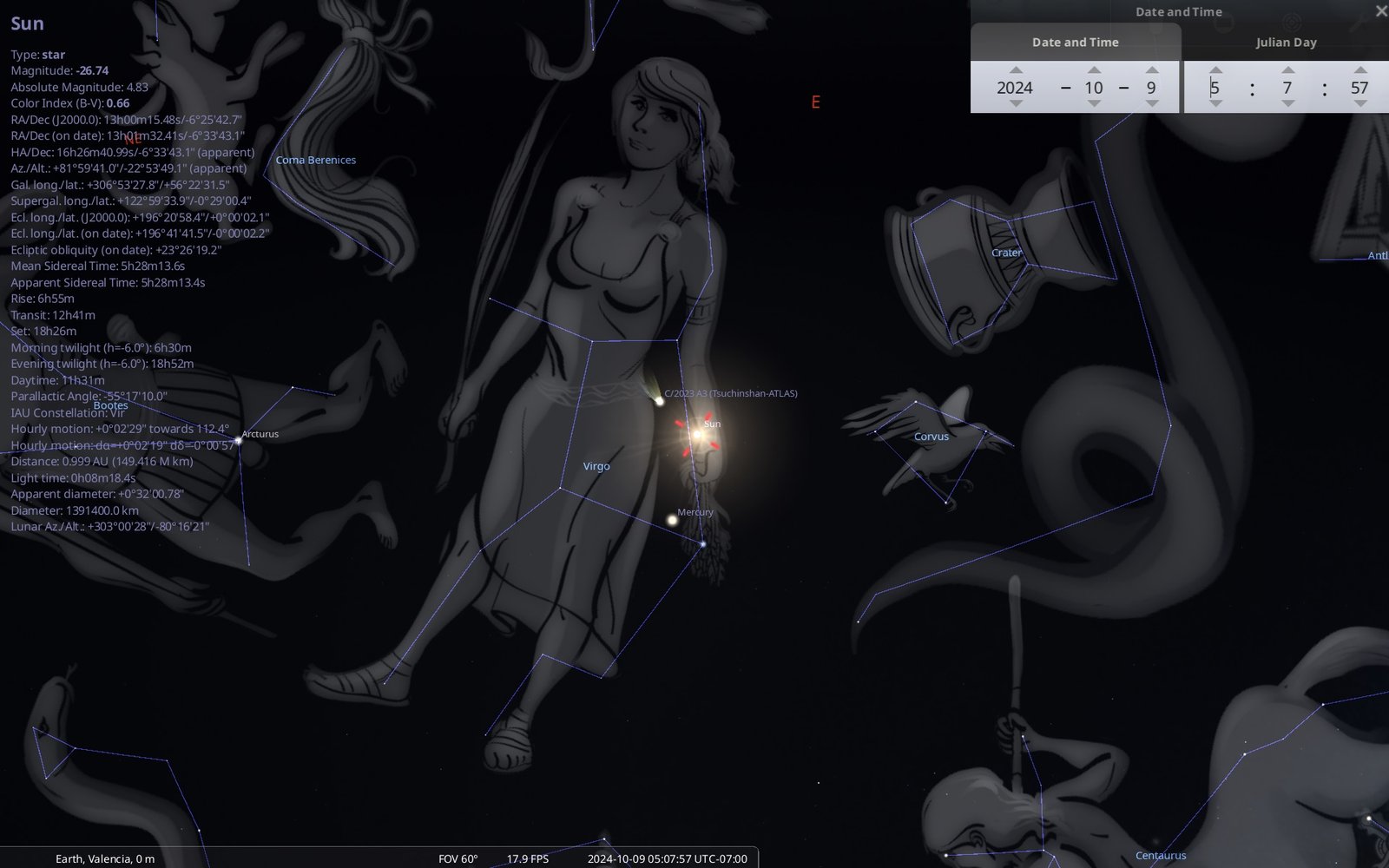
Now, for all you stargazers out there—when can you see it? C/2023 A3 is expected to make its closest approach to Earth on October 12 of 2024; however, it is expected to be the brightest on or around October 9, 2024. During this time, it could be visible with binoculars or even the naked eye in dark areas. Keep an eye on the sky, especially during early mornings or late evenings.
Comets are more than just beautiful sights; they’re like time capsules from the early solar system. Studying them helps scientists understand the origins of our planetary system, and maybe even the building blocks of life.
Comet Tsuchinshan-ATLAS the night of September 27, 2024 | Stellarium
If you want to catch a glimpse of Comet C/2023 A3, here are some tips:
Grab a pair of binoculars or a telescope if you have one.
Find a dark location away from city lights.
Use a stargazing app to help you locate it in the sky.
Take some snacks—you might be out there for a while!
That’s it for today’s cosmic adventure!
Are you excited to see Comet C/2023 A3? Let us know!
Comet C/2023 A3 the night of October 9, 2024 | Stellarium
Don’t forget to subscribe to our YouTube channel and hit that notification bell for more space updates.
Until next time, keep looking up!
Sources: I.A.U. Minor Planet Center / NASA – JPL – CalTech Small Body Database
Today’s Lunar Eclipse will start a series of awe inspiring astronomical events that will span for months and which will culminate with a spectacular planetary alignment.
But let’s focus on today’s event, a lunar eclipse happening on September 17 – 18, 2024, depending where you are in the world.
So, what’s the big deal about this lunar eclipse? For starters, it’s going to be a partial lunar eclipse, which means the Earth will partly cover the Moon.
This isn’t just any lunar eclipse, though. It’s going to be visible from a wide range of locations, including much of North and South America, Europe, and Africa. So, no matter where you are, you might just get a front-row seat to this cosmic show!
Here’s a quick rundown of what to expect:
The eclipse will begin with the partial phase around 5:41 pm PST [12:41 am UTC on Spetember 17 [18 UTC] where the Moon will start to slip into Earth’s shadow. The maximum eclipse will start around 7:44 p,m. PST [2:44 a.m. UTC on Septemner 18] and will last for approximately 30 minutes. The entire event will conclude with the partial eclipse ending around 9:47 p.m. PST on Spetember 17 [4:47 a.m. UTC on September 18].
If you want to catch the best view, you’ll need to find a spot with a clear, unobstructed view of the sky. You don’t need any special equipment to see the eclipse—just your eyes will do. However, if you have a telescope or binoculars, you’ll get a fantastic close-up view of the Moon’s surface and the shadow play.
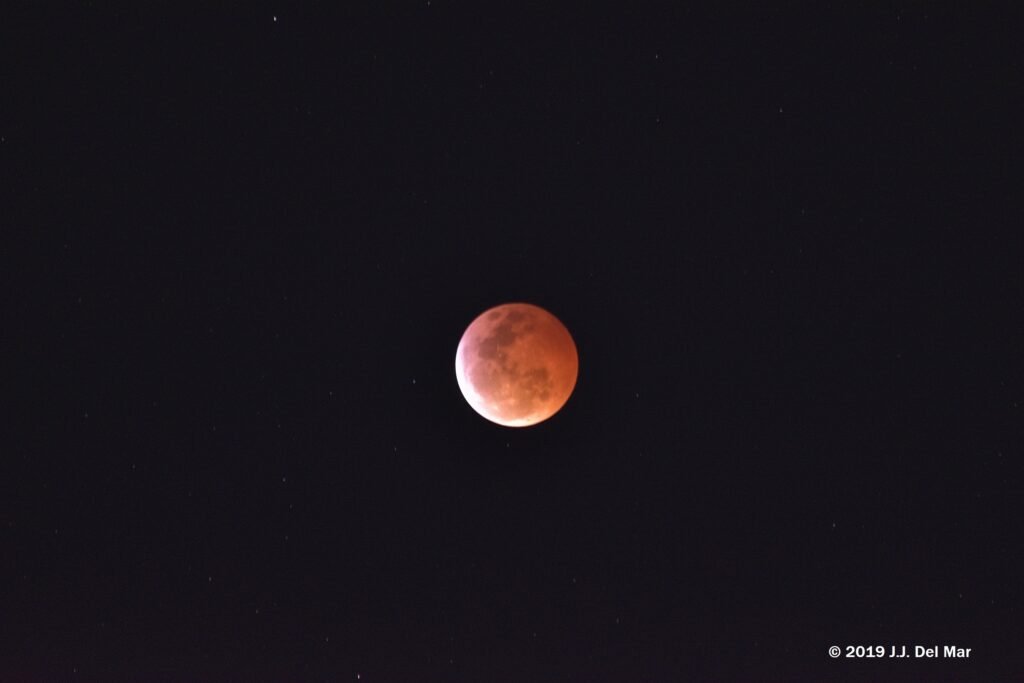
Blood Moon 2019
One of the most incredible parts of a lunar eclipse is seeing the Moon change colors. As the Earth’s shadow slowly moves across the Moon, you’ll notice it turn from a bright white to a deep red, with shades of orange and brown in between. This happens because of a phenomenon called Rayleigh scattering, which causes the shorter blue wavelengths of sunlight to scatter out of the Earth’s shadow while the longer red wavelengths pass through.
For those of you who love stargazing or just want to witness something spectacular, this is definitely an event you won’t want to miss. It’s a beautiful reminder of the vastness and wonder of our solar system.
A couple of quick tips: make sure you’re in a place with minimal light pollution, and consider bringing a blanket or chair to make your viewing more comfortable. And, of course, don’t forget your camera if you want to capture the moment!
Thanks for stopping by, and see you next time!
If you’re new here, don’t forget to hit that subscribe to our YouTube channel and ring the bell so you don’t miss any of our future content.
Whether you are in Mexico, the United States or Canada, you are set for a fascinating cosmic event. The Total Solar Eclipse of 2024 will be witnessed this April 8 by over 37 million people who will be in its path in the three countries that make North America.
Path of the 2024 Eclipse in North America | Great American Eclipse . com
The two northern Maria Islands, Islas Marías, in Mexico will be the first inhabited places to see the Total Solar Eclipse in North America.** The first continental city to witness the event in North America will be the mid-size city of Mazatlán in the sate of Sinaloa, Mexico. The path of the eclipse will let people in well known cities in Mexico, the United States, and Canada see the cosmic spectacle.
Animation by NASA Goddard
These are some places where to see the totality of the Eclipse in MEXICO:
Revillagigedo Islands: Socorro Island Isla Socoro – **Mexican military post, no public access
María Islands: Maria Madre Island Isla María Madre /San Juanito Island Isla San Juanito [north Isla María Magdalena, no totality in Isla María Cleofa]
Mazatlán / El Habal / Puerta de Canoas / El Chilillo
El Salto
Durango [City]
Ciudad Canatlán / El Progreso / Nuevo Ideal / Santiago Papasquiaro
Diez de Octubre / Rodeo / Nazas
Francisco I. Madero [Durango] / Guadalupe Victoria / Emiliano Zapata / Cuencamé
Torreón / Gómez Palacio Metropolitan Area
Francisco I. Madero [Coahuila] / Concordia / San Pedrode las Colonias
Mapimí Biosphere Reserve [Reserva de la Biósfera Mapimí ] / Laguna de Palomas / Salina Laguna de Palomas in Chihuahua State
Laguna del Rey[Coahuila]
Cuatro Ciénegas
San Buenaventura / Nadadores
Monclova / Ciudad Frontera
Sabinas / Nueva Rosita / Palau/ Múzquiz
Allende / Zaragoza / Nava
Piedras Negras
Ciudad Acuña
*Bear in mind that Mexico does not have summer savings time anymore. So most of Mexico is U.S. CST [winter time] and not CDT, but minus one hour during this time of year for the Pacific Coast in Mazatlán.
Time is based onthe beginning of totality in Mazatlán, México 12:06 CST / *1:06 CDT [11:06 am local time].
It will take approximately five more minutes to reach Durango, México 12:11 CST and ten more minutes to reach Torreón, México 12:16 CST.
If you live in the United States, you will have around 20 more minutes to start seeing totality in Texas. *13:26 CDT
These are some places where to see the totality of the Eclipse in the UNITED STATES:
TEXAS
Eagle Pass
Del Rio
Carrizo Springs / Crystal City / Uvalde / Hondo
[West] San Antonio
Kerrville / Bandera / Boerne / Lakehills
Austin
Round Rock / Georgetown
Killeen / Temple / Waco
Dallas – Fort Worth Metro [No totality in Denton]
Corsicana / Athens
Greenville / Bonham
Tyler
Mount Pleasant / Paris / Texarkana
OKLAHOMA
Broken Bow / Idabel
Hugo / Antlers / Rattan
Poteau
ARKANSAS
Ashdown / Texarkana / Hope
Hot Springs
Russelville
Conway
Little Rock / Benton
Searcy
Jonesboro
MISSOURI
Poplar Bluff
Dexter / New Madrid / Sikeston
Jackson / Scott City / Charleston
ILLINOIS
Cairo
Murphysboro / Carbondale / Marion
Metropolis
Mount Vernon / Centralia
KENTUCKY
Paducah
Marion
Henderson
INDIANA
Evansville / Vincennes
Terre Haute
Indianapolis
Marion / Anderson / Muncie
Bloomington / Columbus / Seymour
Richmond
OHIO
Hamilton / Middletown [north / northwest Cincinnati]
Dayton / Spingfield
Lima / Findlay / Toledo
Dublin [northwest Columbus] / Delaware / Marion
Cleveland / Akron
MICHIGAN
Northeast Toledo Metro Area / North Lost Peninsula
PENNSYLVANIA
Erie
Meadville
NEW YORK
Jamestown
Buffalo
Rochester
Syracuse
Watertown / Fort Drum / Plattsburgh
VERMONT
Burlington
Montpelier / St Johnsbury
Enosburg / Morrisville / Newport
NEW HAMPSHIRE
Lancaster
Groveton
Colebrook
MAINE
Bingham / Greenville / Guilford / Dover-Foxcroft
Lincoln / Millinocket / Houlton
Ashland / Presque Isle / Caribou / Mars Hill
These are some places where to see the totality of the Eclipse in CANADA:
Leamington / Blenheim / Ridgetown / St Thomas / Port Stanley
Brantford / Hamilton
St. Catharines / Niagara Falls / Welland
Quinte West / Belleville / Napanee
Kingston / Gananoque / Cornwall
South Montreal / Longueuil
Saint-Jean-sur-Richelieu / Saint-Hyacinthe / South Drummondville / Granby
Sherbrooke
Thetford Mines / Black Lake / Saint-Georges / Lac-Etchemin
Miramichi / Tracadie-Sheila / Richibucto
Alberton / Summerside / Kensington / North Rustico
Îsles de la Madeleine [Madeleine Islands]
Stephenville / Mouse Island / Port aux Basques
Burgeo / Pool’s Cove
Millertown / Buchans
Grand Falls-Windsor / Bishop’s Falls
Clarenville / Little Heart’s Ease / Little Catalina
For more about the Sun, the Moon, and our Solar System visit our planet page here.
Spaceship Starship 9 of the Space X company exploded today during a test flight at the company’s space port in Boca Chica, Texas near the border with Mexico.
The Space X team was carrying out a test climb to 10 km and testing telemetry during the spaceship’s flight.
Moments before the landing, one of the engines did not fire and the controlled fall failed to stop Satrship 9 from crashing at the landind platform.
Space X Flight Test on February 2, 2021 at Boca Chica, Texas
Starship 9 Explosion | Video of the test flight
Today’s test flight is another in a series of tests Space X has been conducting in the last months.
Astronomers, astrophysicists, astrobiologists, geologists, and other scientists have long looked for a Super Earth as an answer to perturbations in the orbits of the outer Solar System planets. They have looked for an unknown X planet, hence “Planet X.”
As a result of this search the outer Solar System has been expanding its limits to farther reaches.
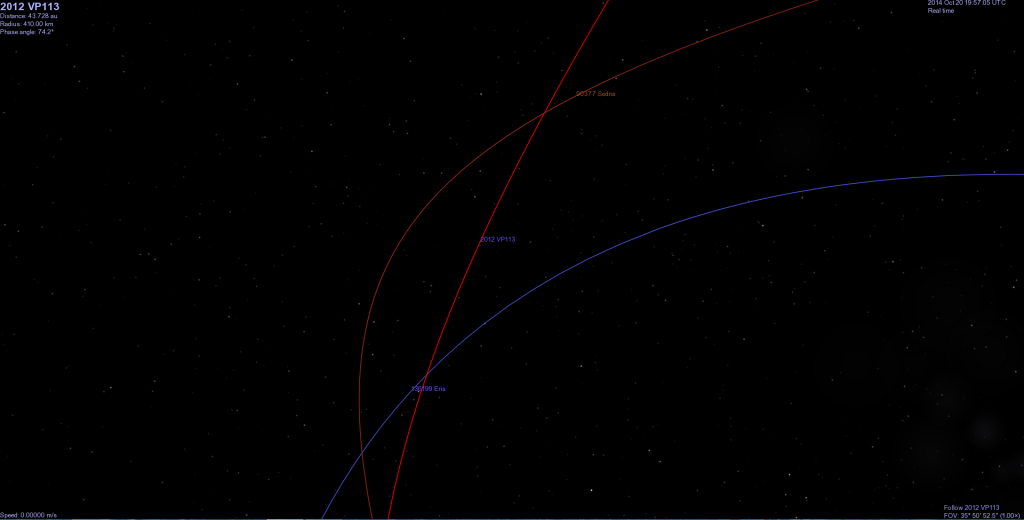
2012 VP113, Celestia | Rediscovered Astronomy
Early Search For Planet X
After the discovery of Uranus by William Herschel in 1781, astronomers suspected the presence of an unknown yet to be discovered planet. Scientists thought that an X planet would be the cause of perturbations to Uranus orbit. In 1821, through math calculations, Alexis Bouvard demonstrated the influence of another planetary body over Uranus.
Uranus, Keck II
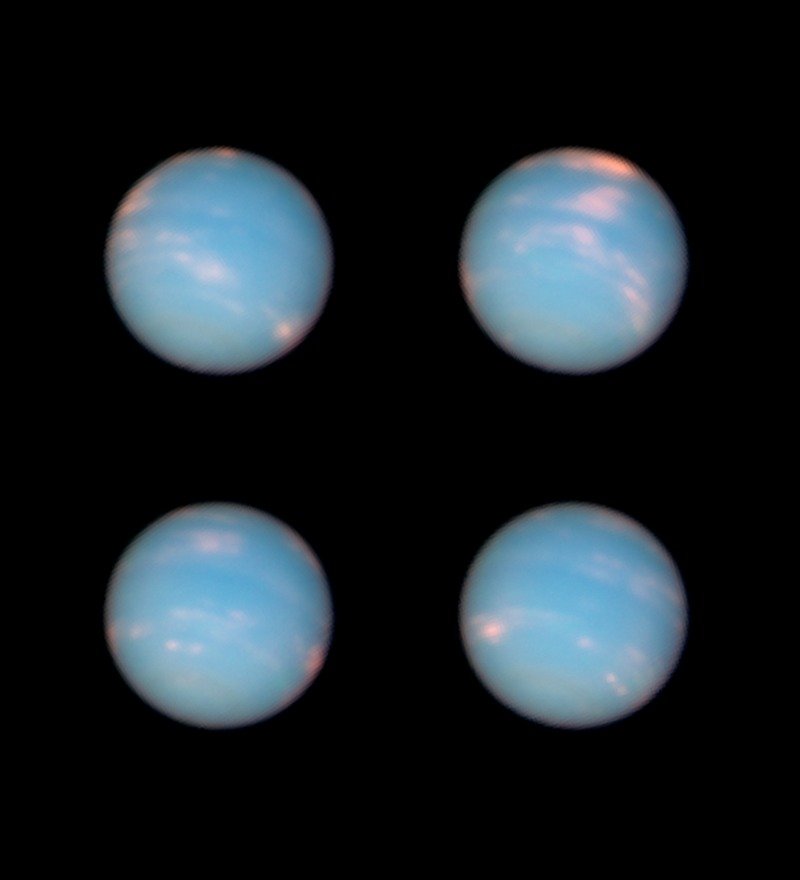
Other astronomers followed up on the work of Bouvard and in 1845 Urbain Le Verrier came to the same conclusion. In the period of 1845 to 1846 both John Couch Adams and Johann Gottfried Galle observed Neptune. Neptune was then credited with the perturbations in the orbit of Uranus.
Neptune, Hubble Space Telescope
Later on, at the beginning of the XX century, Percival Lowell perceived perturbations in Uranus that were not explained by the presence of Neptune at that time. It was assumed a planet X was the cause of Lowell’s calculations. Then in the following years, after the work of Lowell, Clyde Tombaugh discovered Pluto in 1930.
It was assumed for decades that Pluto was the perturber of Uranus [and Neptune].
Pluto and moons, HST
But Pluto turned out to be too small to account for any perturbations to either Uranus or Neptune. It wasn’t until Pluto’s largest moon, Charon, was observed (in 1978 by James W. Christy) that Pluto’s actual size and mass were determined.
If there were any perturbations to Uranus and/or Neptune, they were not caused by Pluto.
Later Search for Planet X
Robert S. Harrington of the U.S. Naval Observatory, continued the search for a planet x that would explain perturbations in the orbits of Uranus and Neptune.
In a research paper entitled, The Location of Planet X, Harrington postulated that the unknown planet could be in the Scorpius or Taurus regions of the sky. Link to PDF
Robert S. Harrington later published a second paper in 1991 entitled, The Search for Planet X, that explained the state of his search in the southern skies.
Harrington continued with his search up to the time of his passing in 1993. Link to PDF
R.S. Gomes and Sylvio Ferraz-Mello also based their search for Planet X on the perturbations of Uranus and Neptune.
This particular theory for the existence of Planet X was discarded due additional calculations that attributed the perturbations proposed by Lowell, Harrington, Gomes, and others to Neptune or to simple “miscalculations”.
However, new theories were proposed in the later 1990s and at the turn of the century.
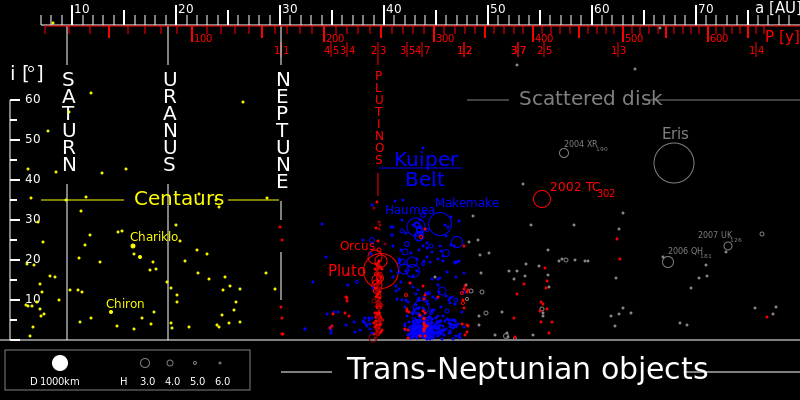
Trans-Neptunian Objects up to 80 AU
Planet X And the Comet Theories
Richard A. Müller postulated the existence of a stellar [or sub-stellar] companion to the sun. Müller’s Nemesis theory aimed at explaining periodic mass extinctions on Earth by way of Oort cloud comets. This red dwarf would be located outside the Oort cloud.
Despite Müller’s proposal, new geological research by Melott and Bambach (in 2010 and 2012) would determine that there existed a significant difference in the period of extinctions by millions of years contrasting the periodicity proposed by Müller.
However, a newer study by Michael R. Rampino (in 2014) suggest the periodicity in mass extinctions on Earth could be much shorter to around 30 million years. Rampino attributes this much shorter period to the Galactic tidal forces perturbing the Oort cloud comets when the sun passes through the galactic disc.
Others attributed the periodic extinctions to statistical error or argued that no astronomical observations showed the presence of a stellar companion to the sun.
Also in the 1990s, John Matese, Daniel Whitmire, and Patrick Whitman came up with a theoretical brown dwarf, Tyche. Tyche would also explain the disruption of non-periodic comets from the Oort cloud. However, other astronomers have recentlty looked for Tyche by analyzing IRAS and WISE surveys. Consequently, NASA’s staff has stated that a large “Saturn-like” or “Jupiter-like” object was not found in the astronomical surveys WISE or AII WISE.
Yet, new discoveries in the next century only deepened the search for an unknown Planet X.
Y Class Brown Dwarf, JPL – Artist
The Search for Planet X In the New Century
Briefly after the turn of the century, in the new millenium, something extraordinary occurred. Michael E. Brown, Chad Trujillo, and D. Rabinowits announced the discovery of Sedna in 2003. Sedna would prove to be a key player in the search for Planet X and new minor planets.
Sedna is small, roughly 1000 km. But Sedna’s orbit takes it much farther away than Pluto at 76 Astronomical Units perihelion [closest approach to the sun] and 940 Astronomical Units aphelion [farthest point from the sun]. Astronomers could not explain Sedna’s presence in that part of the Solar System, something must have acted as a perturber beyond Pluto; probably an unknown massive body or Planet X.
The planetoid Sedna turned out to be of great importance because of its key role to point to a probable massive body perturbing the outer Solar System.
Eris plus Sedna and 2012 VP113 orbits near closest approach to the sun
Michael Brown announced the discovery of yet another body in 2005, Eris.
Eris is bigger than Pluto and would prompt the entire reconsideration of what a planet is by the IAU in 2006 and a new type of planet, the dwarf planet. Eris and Pluto would ultimately both be renamed dwarf planets.
Neither Eris size or its location in the Kuiper belt explains Sedna’s orbit or its very presence towards the Oort cloud. Scientists could not explain why Sedna was there. Astronomical records started to point to a massive body as the perturber, Planet X had to be there.
Besides their Tyche theory, and before it [Tyche] was put down by some opposing astronomers, Matese and Whitmire came up with a new theory in 2006.
John Matese, Daniel Whitmire, and Jack Lissauer pointed out that a wide orbit sub-stellar planetary mass body was the perturber of Sedna to have put it into such an elongated orbit [76 Astronomical Units to 940 Astronomical Units].
Their massive body would be around 800 Astronomical Units away and get closer to the sun at 76+ Astronomical Units to have taken Sedna out of the Kuiper belt or scattered disk region to its current aphelion of 940 Astronomical Units.
Matese and Whitmire followed the work of Gomes (of 2005) with resonant mechanisms and objects with orbits at 40 Astronomical Units to 260 Astronomical Units. They also looked at the research of Morbidelli and Levison (of 2004) of a low mass star or brown dwarf at 800 Astronomical Units that could act as a perturber, a planet x.
Matese, Whitmire, and Lissauer explained that although they were looking for a sub-stellar body, their model works as well for a body the mass of Neptune and less than 2000 Astronomical Units (aphelion) away.
Such an object could not have been detected by the WISE surveys.
Sedna, Eris, and 2012 VP113 Orbits – Rediscovered Astronomy
Current Planet X Research
The discovery of 2012 VP113 in early 2014 by Scott Sheppard and Chad Trujillo supports and extends the current theories that propose the presence of another planet in the outer Solar System. 2012 VP113 [nicknamed Biden] lies at 80 Astronomical Units perihelion and 445 Astronomical Units aphelion.
Sheppard and Trujillo think a planet, a massive Earth, may be out there and expressed WISE / All WISE is not a suitable survey to look for a body up to 10 times the size of Earth and less massive than Saturn.
It did not take long for astronomers to propose a new theory about Planet X.
In that first paper (of June 2014), De La Fuente & De La Fuente, proposed the existence of a “Super Earth” at 200 Astronomical Units. This massive Earth could explain the presence of Sedna and objects like it. They analyzed the orbits of 13 objects with the Kozai effect model. The researchers think there may be two of these Super Earths, one at 200 Astronomical Units and another at 250 Astronomical Units in a 3 to 2 orbital resonance with each other.
The Orbits of Planets and Minor Planets in our Solar System, Celestia
Despite the multiple theories favoring the planet, some astronomy websites resisted to admit that Planet X research continues. It has never been absent from scholarly work.
Some of them cited the work of Michael Brown (co-discoverer of Sedna and Eris), but do not mention the work of multiple other astronomers that have proposed theory after theory favoring Planet X.
For years, Michael Brown refused to say that a massive planet may exist out there. He has been forced to admit there is “something” else that had to act as a perturber. He did say that there must be more planetoids to be discovered and maybe, only maybe, one more planet about the mass of Earth. {link to PDF}
Credit to whom credit is due, Michael Brown will go in History records for the discovery of Sedna and Eris, but he is not the proponent of these new theories and he missed the presence of 2012 VP113.
2012 VP113 – Biden
The search for a massive planet [from 2 – 10 Earth masses] has never stopped regardless of the poor research some Space/Astronomy news websites exhibit when making editorial decisions. They will only publish after the NASA News website or newswire services, but the work of some of the astronomers is only found through university databases and has not appeared on [NASA] News or newswire services.
Other theories might as well explain the presence of Sedna and 2012 VP113 [including Brown’s own theories – and his newer position about Planet X with his Planet 9 research along Konstantin Batygin – Evidence for a Distant Giant Planet in the Solar System ]. But that is not to say Planet X has not been researched by scholars or that only new age book sellers write about it.
Update Fabruary 2022
Despite constant attempts from rival astronomers trying to constraint the search to the Kuiper Belt and smaller bodies like Eris or a a body twice the mass of Mars at or around 60 Astronomical Units, Carlos De La Fuente and Raul De La Fuente recently found that there is evidence for the presence of a body or more than one large planet farther than 150 A.U. or 339 A.U.
Sedna, 2012 VP113 y el elusivo orbe llamado Planeta X
Astrónomos, astrofísicos, astrobiólogos, geólogos y otros científicos han buscado por mucho tiempo una Súper Tierra que dé respuesta a las perturbaciones en las órbitas de los planetas del Sistema Solar exterior. Los científicos han buscado un planeta desconocido, de ahí el término “Planeta X”.
Como resultado de su búsqueda, el Sistema Solar ha expandido sus límites a distancias cada vez más lejanas.
2012 VP113, Celestia | Rediscovered Astronomy
Primeras Búsquedas
Después del descubrimiento de Urano en 1781 por William Herschel, los astrónomos sospecharon la presencia de un planeta desconocido aún por descubrir. Los científicos pensaron que un planeta X sería la causa de perturbaciones en la órbita de Urano. En 1821, Alexis Bouvard demostró por medio de cálculos matemáticos la influencia de otro cuerpo planetario sobre Urano.
Urano, Keck II
Otros astrónomos continuaron el trabajo de Bouvard, y en 1845, Urbain Le Verrier llegó a la misma conclusión. En el periodo entre 1845 y 1846 tanto John Couch Adams como Johann Gottfried Galle observaron a Neptuno. Entonces las perturbaciones en la órbita de Urano se le atribuyeron a Neptuno.
Neptuno, Hubble
Posteriormente, a comienzos del siglo XX, Percival Lowell percibió perturbaciones en la órbita de Urano que no fueron resueltas en ese entonces con la presencia de Neptuno. Se asumió que un planeta x era la causa de los cálculos hechos por Lowell. En los siguientes años, basado en el trabajo de Lowell, Clyde Tombaugh descubrió Plutón en 1930.
Por décadas se asumió que Plutón era el perturbador de Urano [y Neptuno].
Plutón y sus lunas, Hubble
Sin embargo, Plutón resultó ser demasiado pequeño para provocar cualquier perturbación a las órbitas de Urano o Neptuno. No fue sino hasta el descubrimiento de Caronte, la luna más grande de Plutón, (por James W. Christy) que se determinaron el tamaño y masa reales de Plutón.
Si existían perturbaciones en las órbitas de Urano y/o Neptuno, Plutón no era la causa.
Búsqueda Posterior del Planeta X
Robert S. Harrington, del Observatorio Naval de los EEUU, continuó la búsqueda de un planeta x que pudiera explicar las perturbaciones en las órbitas de Urano y Neptuno.
En un estudio científico titulado: La Ubicación del Planeta X, Harrington postuló que el planeta desconocido podría estar en las regiones estelares de Escorpión o Tauro.
Robert S. Harrington publicó después en 1991 un segundo estudio titulado: La Búsqueda del Planeta X, en el cuál explicaba el estado de la búsqueda hacia los cielos del hemisferio sur.
Harrington continuó con su búsqueda hasta el momento de su fallecimiento en 1993.
R.S Gomes y Sylvio Ferraz-Mello también basaron su búsqueda del Planeta X en las perturbaciones a las órbitas de Urano y Neptuno.
En particular, esta teoría de la existencia del Planeta X se desechó debido a que se hicieron cálculos adicionales que atribuyeron las perturbaciones propuestas por Lowell, Harrington, Gomes, y otros a Neptuno o a simples “errores de cálculo”.
Sin embargo, se propusieron nuevas teorías en la década de los años 90 y al comienzo del nuevo siglo.
Objetos Trans-Neptunianos hasta 80 UA
El Planeta X y las Teorías de los Cometas
Richard A. Müller postuló la existencia de un compañero estelar [sub-estelar] del sol. La teoría de Némesis de Müller trataba de explicar las extinciones masivas periódicas en la Tierra por medio de cometas provenientes de la Nube de Oort. Esta estrella enana roja se encontraría afuera de la Nube de Oort.
A pesar de la propuesta de Müller, nuevos estudios geológicos por parte de Melott and Bambach (2010 and 2012) determinarían que existía una diferencia significativa de millones de años en los periodos de extinciones masivas que diferían de los periodos propuestos por Müller.
Sin embargo, un estudio más reciente de Michael R. Rampino (2014) sugiere que el periodo de extinciones masivas en la Tierra pudiera ser mucho más corto, alrededor de 30 millones de años. Rampino atribuye este periodo extremadamente más corto a fuerzas galácticas que perturban los cometas de la Nube de Oort cuando el sol pasa por el disco galáctico.
Otros atribuyeron las extinciones masivas periódicas a errores estadísticos o argumentaron que no se tenían observaciones astronómicas que demostraran la presencia de un compañero estelar del sol.
Igualmente en la década de los años 90, John Matese, Daniel Whitmire, and Patrick Whitman postularon la teoría de una estrella café enana, Tyche. Tyche también explicaría la perturbación de los cometas de la Nube de Oort no periódicos.
Sin embargo, otros astrónomos buscaron a Tyche al analizar las búsquedas estelares de IRAS y WISE. Consecuentemente, personal de la NASA ha dicho que no se ha encontrado un cuerpo del tamaño de Saturno o Júpiter en las búsquedas astronómicas WISE o AllWISE.
No obstante, nuevos descubrimientos en el siguiente siglo profundizaron la búsqueda de un desconocido Planeta X.
Enana Café Clase Y, JPL – Artista
La Búsqueda del Planeta X en el Nuevo Siglo
Poco tiempo después del comienzo del nuevo siglo, y del nuevo milenio, ocurrió algo extraordinario. Michael E. Brown, Chad Trujillo y D. Rabinowits anunciaron el descubrimiento de Sedna en el año 2003. Sedna se convertiría en un protagonista clave en la búsqueda del Planeta X y de nuevos cuerpos menores.
Sedna es pequeño, casi 1, 000 km, pero la órbita de Sedna lo lleva mucho más lejos que Plutón a 76 UA perihelio [distancia más cercana al sol] y 940 UA afelio [punto más lejano al sol]. Los astrónomos no podían explicar la presencia de Sedna en esa parte del Sistema Solar. Algo debió haber actuado como perturbador más allá de Plutón; probablemente un cuerpo masivo o Planeta X.
El planetoide Sedna resultó ser de gran importancia debido a su papel clave en señalar la probable existencia de un cuerpo masivo que perturba el Sistema Solar exterior.
Eris más Sedna y 2012 VP113 – orbitas casi al punto más cercano al sol
Michael Brown anunciaría el descubrimiento de otro cuerpo en el año 2005, Eris.
Eris es más grande que Plutón y provocaría una total reconsideración por parte de la UAI de lo que constituye un planeta y la clasificación para un nuevo tipo de planeta, el planeta enano. Al final, tanto Eris como Plutón fueron reclasificados como planetas enanos.
Ni el tamaño de Eris ni su ubicación en el Cinturón de Kuiper explica la órbita de Sedna o su misma presencia hacia la Nube de Oort. Los científicos no podían explicar por qué Sedna estaba allí. Los registros astronómicos comenzaron a señalar a un cuerpo masivo como el cuerpo perturbador, el Planeta X tenía que estar allí.
Además de la Teoría de Tyche, y antes de que [Tyche] fuera descartada por astrónomos contrarios a ellos, Matese and Whitmire postularon una nueva teoría en el año 2006.
John Matese, Daniel Whitmire y Jack Lissauer piensan que un cuerpo sub-estelar masivo y de órbita amplia es el perturbador de Sedna para haber puesto a este último cuerpo en una órbita tan alargada [de 76 UA a ~940 UA].
El cuerpo masivo que Matese y su equipo postulan estaría a 800 UA y se acercaría hasta +76 UA para haberse llevado a Sedna lejos del Cinturón de Kuiper o del Disco Disperso hasta su actual afelio de 940 UA.
Matese y Whitmire se basaron en parte en el estudio de Gomes (2005) de mecanismos resonantes y objetos con órbitas de 40 UA a 260 UA. También mencionan la investigación de Morbidelli y Levison (2004) acerca de una estrella de baja masa o estrella café enana a 800 UA que pudiera estar actuando como perturbador, un planeta x.
Matese, Whitmire y Lissauer explicaron que aunque ellos estaban buscando un cuerpo sub-estelar, su modelo también funciona para un cuerpo de la masa de Neptuno y a menos de 200 UA (afelio) de distancia.
Tal objeto puede no haber sido detectado con las búsquedas estelares de WISE.
Sedna, Eris y 2012 VP113, órbitas – Rediscovered Astronomy
Investigación Actual del Planeta X
El descubrimiento de 2012 VP113 a principios de 2014 por parte de Scott Sheppard y Chad Trujillo apoya y extiende las teorías que proponen la presencia de otro planeta en el Sistema Solar exterior. 2012 VP113 [apodado Biden] yace a 80 UA perihelio y ~445 UA afelio.
Sheppard y Trujillo piensan que puede existir una Tierra masiva y han expresado que WISE / AllWISE no es la búsqueda estelar apropiada para encontrar un cuerpo de hasta 10 veces el tamaño de la Tierra y menos masivo que Saturno.
No llevó mucho tiempo para que otros astrónomos propusieran una nueva teoría acerca del Planeta X.
En su primer estudio (junio 2014), De La Fuente y De La Fuente propusieron la existencia de una “Súper-Tierra” a ~200 UA. Esta Tierra masiva pudiera explicar la presencia de Sedna y objetos similares. De La Fuente y De La Fuente analizaron las órbitas de 13 objetos con el mecanismo de Kozai.
Los científicos creen que pudieran existir dos de estas Súper-Tierras, una a 200 UA y otra a 250 UA en una órbita resonante de tipo ~3:2.
Las órbitas de los planetas y planetas menores del Sistema Solar, Celestia
A pesar de las múltiples teorías que favorecen la existencia del Planeta X, algunos sitios de astronomía se resisten a admitir que continúa la investigación acerca del planeta. Nunca ha estado ausente de la investigación científica.
Algunos de esos sitios citan los estudios de Michael Brown (co-descubridor de Sedna y Eris), pero no mencionan los estudios de muchos otros astrónomos que han propuesto teorías y más teorías que favorecen la existencia del Planeta X.
Durante varios años, Michael Brown se negó a decir que puede existir un planeta masivo. Ha sido forzado a admitir que existe “algo” más que tuvo que actuar como perturbador. Brown sí dice que debe haber más planetoides por descubrir y tal vez, sólo tal vez, un planeta más de la masa de la Tierra aproximadamente. {enlace a PDF}
Crédito a quien se lo merece, Michael Brown pasará a la historia por el descubrimiento de Sedna y Eris, pero no es él quien propone estas nuevas teorías, y él no detectó la presencia de 2012 VP113.
2012 VP113 – Biden
La búsqueda de un planeta masivo [de 2 a 10 masas/Tierra] nunca ha parado sin importar la pobre investigación que exhiben algunos sitios de noticias del Espacio/Astronomía en la red al momento de tomar decisiones editoriales. Esos sitios sólo publican después de que lo hace el sitio de noticias de la NASA o después de enterarse de ello a través servicios de cables informativos. Pero los estudios de algunos astrónomos nada más se encuentran en bases de datos de universidades y no aparecen en noticias [de la NASA] o en cables informativos.
Otras teorías pudieran también explicar la presencia de Sedna y de 2012 VP113 [inclusive las teorías de Brown – con su más reciente posición acerca del Planeta X en su investigación junto con Konstantin Batygin del Planeta 9 – Evidencia de un Distante Planeta Gigante en el Sistema Solar]. Sin embargo, eso no significa que no se hacen investigaciones científicas acerca del Planeta X o que sólo los escritores de la nueva era escriben acerca del tema.
Actualización Febrero 2022
A pesar de que astrónomos rivales constantemente intentan restringir la búsqueda al Cinturón de Kuiper o a cuerpos menores como Eris o a uno de dos veces la masa de Marte a unas 60 AU, Carlos De La Fuente y Raúl De La Fuente han encontrado recientemente evidencia que prueba la presencia de uno o dos planetas grandes a más de 150 AU o 339 AU.
Planet X has made it to the headlines again. Planet X is the assumed massive planet that may be the cause of perturbations in the orbits of outer [dwarf] planets like Sedna.
Space news websites such as Space dot com are now publishing this research by Carlos De La Fuente Marcos and Raúl De La Fuente Marcos.
The problem is that this research paper was submitted last June 2014 by the two astronomers from the Universidad Complutense de Madrid, Spain.
Here’s a snapshot of the research paper.
Planet X Research | Extreme TNOs – De La Fuente & De La Fuente, June 2014
The following screen capture from The Cornell University Library shows that the research was submitted back in June 3, 2014 by Raúl De La Fuente Marcos. Here’s the link: http://www.arxiv.org/abs/1406.0715
Extreme TNOs Screen Capture, Raúl De La Fuente
The De La Fuente researchers think there may be at least two massive planets that would explain the presence of Sedna-like objects in the outer Solar System. Their paper was presented a few months after the discovery of probable dwarf planet 2012 VP113 by Sheppard and Trujillo in March of 2014.
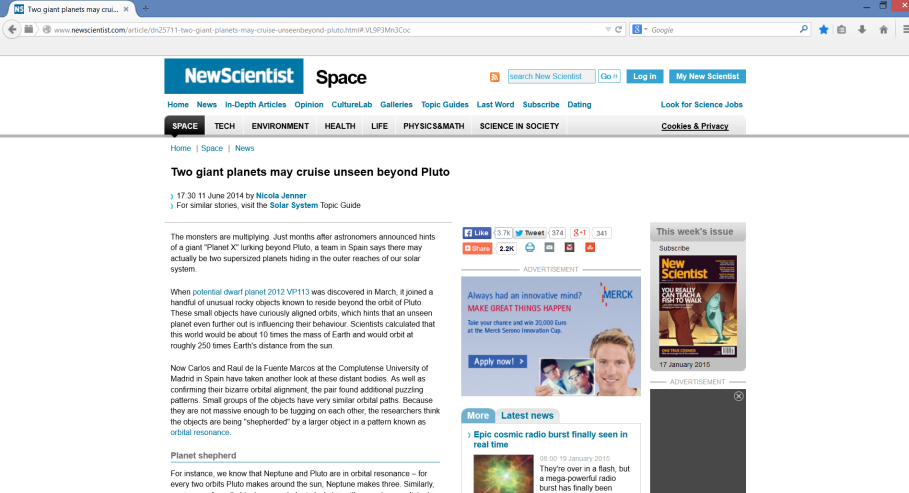
Despite the “omission” of main news media and space news websites, other websites did publish about the topic immediately after the De La Fuentes presented their paper in June 2014. New Scientist article dated June 11, 2014 talks about De La Fuente & De La Fuente massive planet theory [Planet X].
New Scientist published the news June 11, 2014 on their website
Rediscovered Astronomy will publish a more extensive article to show the research to look for a massive planet has been there all the time. The search for a Planet X hasn’t been “revived” [as some space news websites say], it has been there for many decades. [Rediscovered Astronomy worked on some models for Celestia last October 2014.]
A failed sub-orbital flight of a Virgin Galactic spacecraft left one pilot dead and one injured. The spacecraft, Space Ship Two, had detached from its carrier plane White Knight which landed safely. Space Ship Two was supposed to achieve sub-orbital flight but the spacecraft experienced anomalies that caused it to crash land. Virgin Galactic had had previous flights of Space Ship Two with no major incidents. But today’s was a tragic one and it is very sad news for the space community.
Tragedy Strikes Virgin Galactic – Space Ship Two Crash Lands | CNN