This is an animation of the newly proposed planets around Kepler-62. The system in the Lyra constellation is 1200 light years away. Kepler-62 may host two water worlds similar to Earth, Kepler-62 e and Kepler -62 f.
Scientists have found an unknown gas in Titan’s upper atmosphere after analyzing data from the Cassini probe.
Saturn’s moon is the only moon in our solar system with a thick atmosphere comparable to the ones of the inner terrestrial planets. Titan’s atmosphere is mainly made of nitrogen, methane, and hydrogen.
Titan’s Atmosphere
Back in 2004 Cassini had found emissions in Titan’s high atmosphere at an altitude of 500 km. These gases were found to be hydrocarbons. However, upon further observation of the spectral region, García Comas, López Puertas from Spain, and other European astronomers determined other unknown gas was present in the moon. The emissions increased at an altitude of 900 km in Titan’s atmosphere. The emissions that were remotely observed did not fit any other bands in the known atmosphere. It had to be a new undetected band that the astronomers did not see before.
Gases found in Titan
The findings were presented last year during the 2nd National Conference on Laboratory and Molecular Astrophysics in November. The astronomers announced that the emissions were hidden under a layer of methane. They concluded that the strong emission had to be part of another kind of gas. The scientists provisionally named the new band Agnostosphere and they believe its made of aromatic compounds. They also discovered that the band of gas is influenced by solar radiation since it is only found during Titan’s day. The astronomers think this new finding may help to explain the haze in Titan’s upper atmosphere observed by Cassini.
Titan Emission – Haze found in the planet’s atmosphere
Will the Mars Curiosity Rover Suffer the Phobos Effect?
Up to this point we had been amazed by the Mars Science Laboratory (MSL) nicknamed Curiosity. Even after the project manager had announced an unprecedented discovery late 2012 and later retracted. [A common attitude of space scientists under the grasp of the official agency and its subsidiaries.] Despite the disappointment, the MSL robot continued its work on the red planet Mars. The project managers had the MSL do test drilling for practice and then they moved on performing the actual drill last February. The sample rock was to be taken inside the robot to be analyzed by its instruments.
So we all thought the MSL was going to have some progress in order to know what Mars soil is made of. But lo and behold, the Mars Curiosity robot has just suddenly suffered a computer malfunction just when expectation had been raised about actually finding something tangible. According to the official press release from the MSL website, the robot suffered a “memory issue”, the main computer was switched to a back up computer so the rover is now working on “safe mode”. As a consequence, “It did not send recorded data, only current status information”, said the JPL team in charge of the MSL. This means the data from the samples being analyzed was not sent. The team states that they are working to fix the “anomaly.”
So far in space exploration when previous probes have been about to discover something of relevance about Mars or its moon Phobos, they have malfunctioned. So we wonder whether the same effect will be suffered by the MSL.
Let’s wait and see what happens to this expensive piece of…. equipment.
We now know that the MSL team recovered the data. It’s been stated from the analysis of the rocks on the planet that “ancient Mars could have harbored life”. We will wait to see what further analyses are made, and if they are not reverted or discarded as compromised data as has happened with previous Mars missions.
For more about the Red Planet, visit our Mars Page.
Planetary Resources To Build Public Space Telescope
It makes the news again with their announcement today that they plan to build a space telescope for public access.
The company became known for its intent to mine asteroids, and according to their website that is exactly the primary goal.
With today’s announcement that they’re launching a public space telescope, the company is paving the way for other similar entities to really promote science among the general public. ARKYD is the name of the project for the space telescope and Planetary Resources is aming at raising $1,000, 000 to kick start the satellite. People can make contributions of at least $1 U.S. dollar.
Update 7-9-2013
Planetary Resources did meet the goal of raising at least 1 million dollars to start the project.
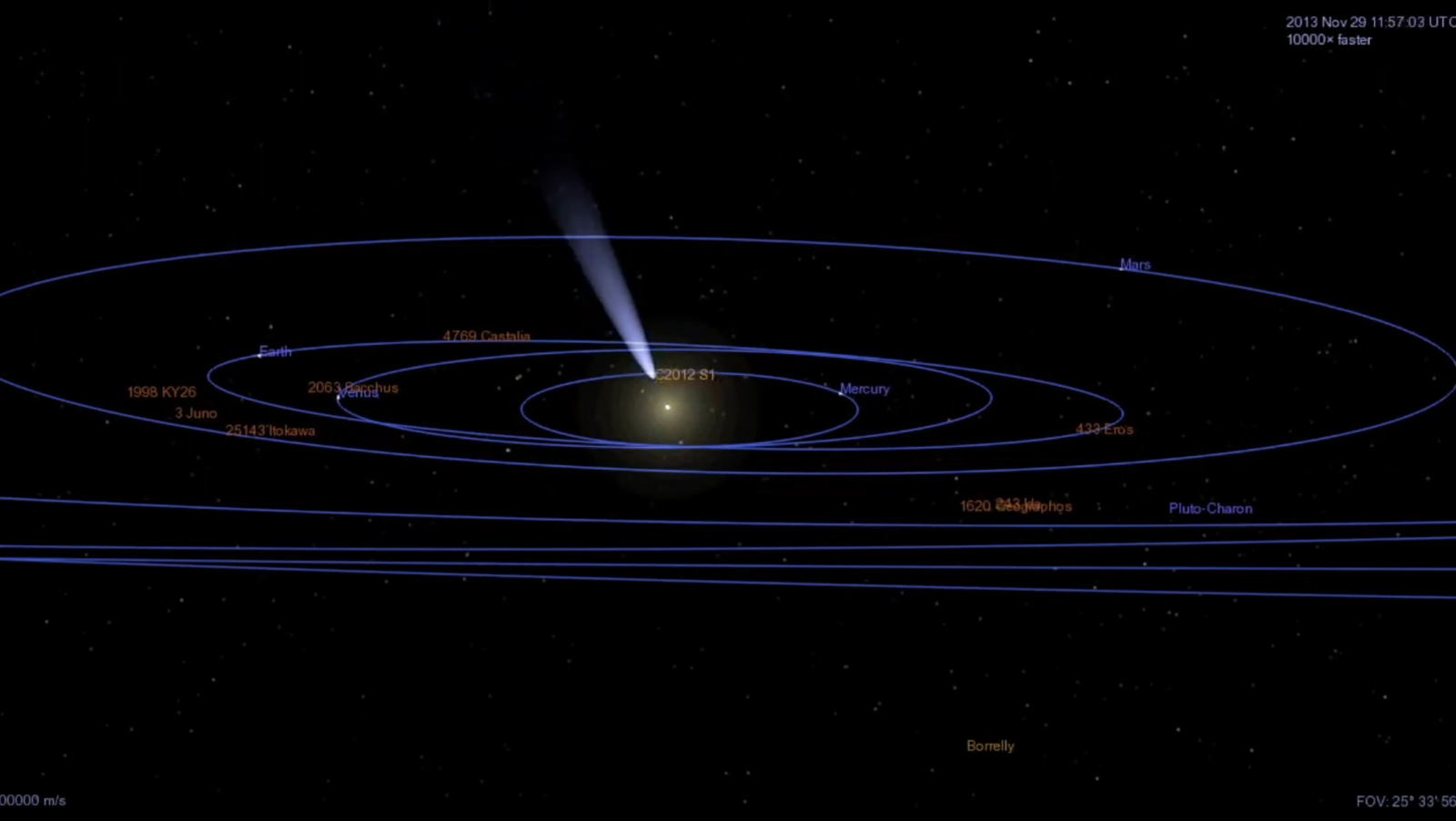
Comet ISON will approach the inner solar system late 2013. In early October 2013, ISON will be closer to Mars than it will ever be to Earth (?). Around November 27 of 2013, c2012 S1 will be orbiting around the sun and it will start its approach to Earth. Provided it is not altered by Sol, comet ISON will create a spectacular view. Some astronomers claim it will be as bright as the moon.
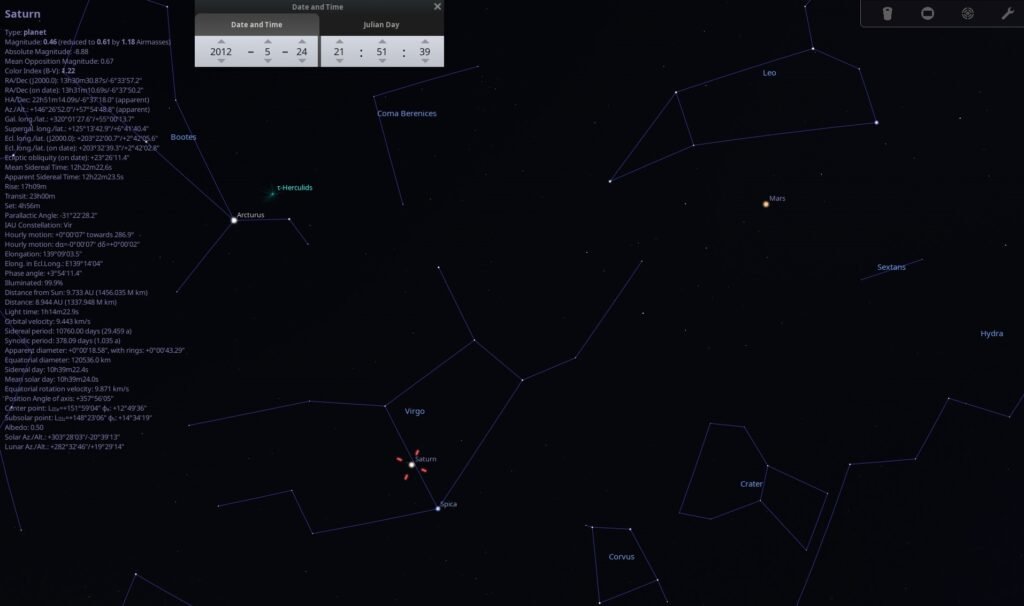
Look Up at the sky tonight you should be able to locate Mars and Saturn in a straight line from Earth’s perspective.
I couldn’t find an available telescope tonight, too bad. Seems I’ll have to acquire my own. But despite what the general public might think, it doesn’t take that much to get hold of a telescope and a digital camera to capture amazing footage of Earth’s companions in the sky.
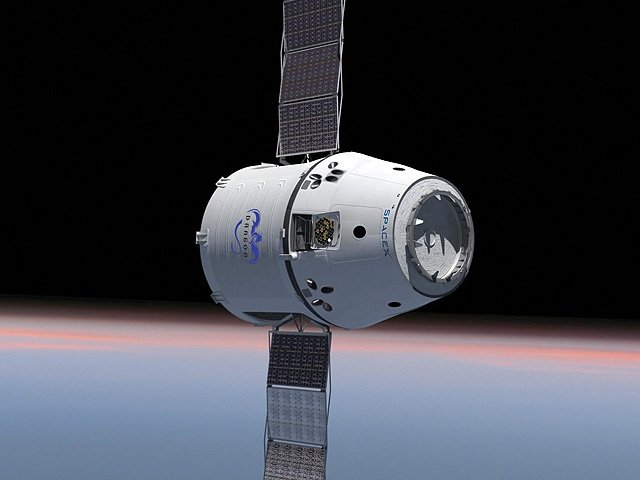
Space X will dock with the International Space Station and land back on Earth. The company will use the Dragon capsule as well the Falcon 9 rockets to achieve the flight.
It looks amazing that finally there’s someone with a vision towards the future. Planetary Resources, Inc. will officially announce April 24, 2012 their plans to mine near Earth asteroids. The company aims at getting metals that are expensive and hard to obtain on Earth such as Platinum.